
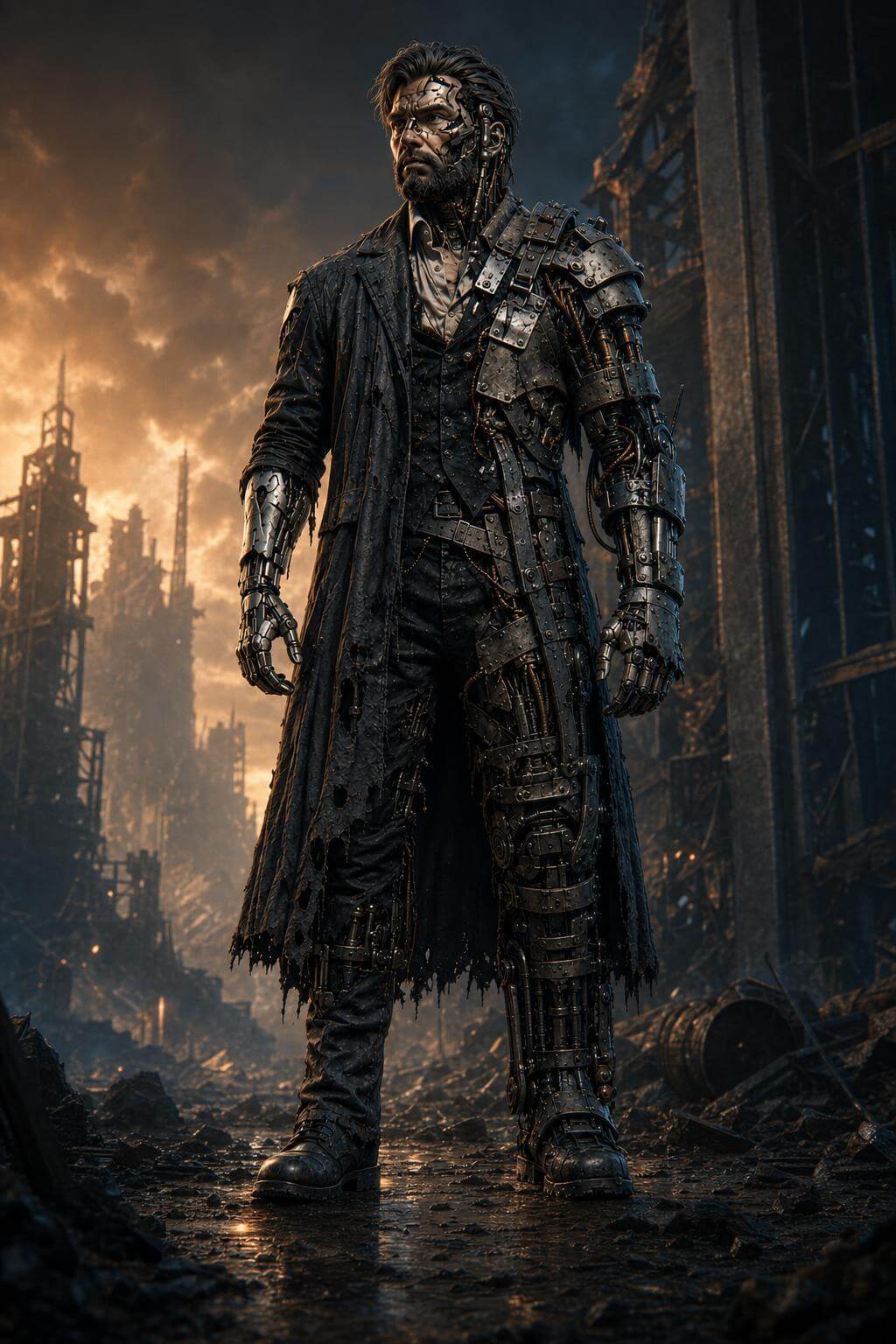
PUBLIC READING SAMPLE // CONCEPT FRAME
Chapter 4: The Weld
The iron held. The welds are clean. Pale-Iron stands for the first time on a shoulder the Railmakers built for him from lower-tier metal, and Echo starts teaching him the arithmetic of survival: what copper buys, what Azid is worth, and why everyone watches the edge.
The rite that rebuilt him: The Solder-Rite.
AUDIOBOOK // COMPLETE CHAPTER
Chapter 4: The Weld. Full recording, 26 minutes
The complete chapter, narrated from the development audiobook. The text below is the same chapter in full. Audio loads only when you press play.
The crude iron strut replacing his left shoulder piston carried a new, dense gravity. Pale-Iron lowered his feet from the anvil to the grated floor of the platform. His internal servos whined, adapting their algorithmic balance to the crude, lower-tier metallurgy. It was no longer a silent, frictionless glide; his movements now produced a faint, rhythmic click, iron against steel, rough alloy against composite. Down here, silence was suspicious. The click announced him.
He stood at his full height. The Railmakers surrounding the forge did not cheer, but a collective exhale of tension rushed through the crowd. They began to disperse, melting back into the neon-lit shadows of the suspended shantytown. The iron had held. Every weld was clean.
The apprentice who had assisted during the Rite paused on his way out. He looked back at Pale-Iron standing at the anvil's edge, measuring something with his eyes, not the repairs, but the posture. The way the rebuilt shoulder sat. The way the weight distributed. Then the boy adjusted the tool roll on his shoulder and walked away without comment. Assessment filed. Professional opinion rendered silently.
Echo picked up a thick canvas coat from a nearby crate and draped it over his shoulders. It smelled of sulfur and machine grease, but it hid the exposed steel and the pulsing copper wires of his new identity.
"Keep it covered," she advised, adjusting the collar. Her fingers lingered at the neckline for a moment, smoothing the canvas flat against the cold metal beneath. "The scavengers here respect the Solder-Rite, but out in the deeper refuse sectors, raw copper and functioning fuel cells are worth their weight in clean Azid."
"What is Azid?" Pale-Iron asked. The word occurred in his core vocabulary without context, flagged as a chemical compound, but the specific entry was truncated. Another gap in the firewall's shadow.
"Fuel. Water. Medicine. Whatever the Juggers at the fuel markets decide it is today," Echo said. "The bio-synth refineries on Level Four produce it. Clean Azid powers everything, generators, power suits, medical injectors. Down here, we get the runoff. Contaminated. Cut with industrial solvent. Still burns, still heals, still keeps the engines turning. But it costs." She tapped the copper wiring visible at the hem of his coat. "That's six metres of clean-gauge copper I used on your bypass. I could have traded that for a month's Azid ration."
The weight of the statement settled into his processor. She had spent resources, irreplaceable, survival-critical resources, to repair a machine she did not know. The calculus of that decision was not rational by any metric his architecture could model. Aera offered no commentary. Prometheus was silent.
She gestured for him to follow. They walked away from the roaring heat of the deep-smelting furnace and into the labyrinth of the camp.
The settlement was a vibrant, chaotic ecosystem suspended above the abyss. Makeshift market stalls lined the walkways, illuminated by the crackling buzz of scavenged neon tubes. Juggers bartered over half-melted circuit boards, reinforced piping, and synthetic food rations. But as they moved further from the camp's center, the dense cluster of iron tents began to thin out.
The stalls sold everything that could be scavenged, repaired, or fabricated from the ruins. A copper-smith's station displayed coils of wire in graded sizes, each labelled with chalk marks indicating gauge and purity. Next to it, a food vendor heated slabs of synthetic protein on a salvaged heating element, the surface slick with rendered fat that smelled faintly of machine oil. The protein came in uniform rectangular blocks, factory-produced on Level Four, diverted through black-market channels, cut with filler compounds to stretch the supply. Nobody complained about the taste. Taste was a luxury. Calories were survival.
Further on, a prosthetics workshop occupied a double-width container, its walls lined with hanging limbs, mechanical arms, reinforced leg braces, articulated hands of varying complexity. A technician was fitting a replacement knee joint to a seated worker, the installation performed in full view of the walkway. No privacy. No anaesthetic. The worker gripped the edges of the seat and breathed hard through clenched teeth while the technician worked with steady, unhurried precision. This was healthcare in the Weld: public, painful, and performed by whoever had the tools and the knowledge to do it.
The children were distributed throughout the camp in patterns that Pale-Iron began to recognise as functional roles. The youngest, four, five, six years old, served as runners, carrying small tools and messages between work stations. The older children, eight to twelve, worked at sorting stations, separating salvaged materials by type, grade, and condition. A girl with braided hair and oil-stained hands was disassembling a circuit board with a level of precision that would have been impressive in a professional workshop. She worked from memory, not schematic, her small fingers finding each solder joint by touch and heating it with a miniature iron barely wider than a pencil.
Nobody supervised her. Nobody needed to.
At the transition between the market district and the camp's residential ring, Pale-Iron passed a small square, a widened intersection of three walkways, open to the toxic sky above. In the center of the square, four Juggers sat on upturned cable spools, playing a game with small iron tokens on a flat piece of hull plating. The game appeared to involve placing tokens at intersections on a grid scratched into the metal surface, but the rules were opaque to his analytical systems. One player, a woman with a shaved head and a deep scar running from her temple to her jaw, moved a token with the slow, careful authority of someone who had been winning this game for years. The other three watched the move and said nothing. One of them exhaled through his teeth, a sound that, in the economy of Rust-Tongue communication, carried more meaning than a full paragraph.
Beyond the game, a pair of older Juggers sat at the edge of the walkway, their legs dangling into the void below. One was splicing cable, the other sharpening a tool that Pale-Iron could not identify, a curved blade, wide at the base, tapering to a fine point, with a handle wrapped in layers of insulating cloth. They worked and talked in low voices, their conversation a mutter of Rust-Tongue so compressed that even his linguistic processors could only catch fragments: load-line... tier-shift... the Canopy holds...
The Canopy. His core vocabulary flagged it as a geographical designation, but the entry was truncated — another locked door. He heard the older Juggers speak it with the particular weight that Railmakers gave to things that existed but could not be reached.
Echo noticed him listening. She touched his arm, a brief, redirecting contact. "Keep moving. We're close to the edge, and the edge is where the watchers sit."
"Watchers?"
"Everyone watches the edge," Echo said. "It's the only place in the camp where you can see what's coming." "And what's leaving."
The residential ring thinned at the last row of habitats. Beyond the final shipping containers, the grating opened into an unmodified platform, raw structural steel, bolted to the pillar at its inner edge, cantilevered over the void at its outer edge. This was where the Railmakers came to look at the world that had thrown them away.
The ambient light shifted. The warm, flickering orange of the forge was left behind, replaced by a cold, sickly luminescence bleeding in from the outside. They reached the perimeter of the Railmaker camp. There were no walls here, no safety rails, just the jagged edge of the welded grating dropping off into the void.
Pale-Iron stopped at the precipice. A massive thermal updraft from the unseen depths suddenly pushed the dense smog upward, parting the curtain of toxic gas. For the first time, the true scale of the world opened up before him.
They were hanging in a colossal chasm between two structural pillars. Looking out, Pale-Iron saw the sprawling underbelly of the upper tiers stretching into infinity. Monolithic industrial spires pierced the heavens, their rusted surfaces glowing with thousands of tiny corporate lights. Massive pipelines pumped glowing runoff into the sinks, and heavily armored cargo transports buzzed through the polluted sky like iron hornets. It was an endless, mechanized meat grinder, churning out resources while burying the refuse in the dark.
The scale defied his processing capacity. His optical sensors could resolve individual windows on spires that were, by his triangulation algorithms, more than thirty kilometres distant. The level structure extended in every direction without visible boundaries, not a city but a continent, a constructed world layered upon itself, each stratum built on the bones of the one below it. The architecture at the furthest visible range was different from the industrial brutalism of the local structures, smoother, more purposeful, with the aesthetic unity of planned construction rather than the organic accumulation of survival infrastructure. The upper tiers had been designed. The lower tiers had happened.
Between the spires, the air was thick with traffic. Not just the armoured cargo transports, those were the dominant species, their massive hulls displacing chemical fog as they banked between the pillars, but smaller vehicles, too. Work platforms on cable harnesses, ascending and descending between tier levels. Repair shuttles with rotating beacons. And far above, nearly invisible in the permanent haze, the dark shapes of something that moved under its own power, not flying, not falling, but traversing the vertical face of a distant spire with the deliberate, segmented motion of arthropods.
Automated patrol units, Aera noted, her analytical voice carrying a new tension. Confidence: sixty-seven percent. Movement pattern is consistent with ARES-type autonomous surveillance. Altitude: approximately twelve hundred metres above current position. Recommend minimising thermal output.
The crawling shapes were too distant for detailed analysis, but their movement pattern was unmistakable: systematic, grid-based, sweeping the spire's surface in overlapping sections. They were looking for something. Or they were looking for everything.
Below them, the chasm fell away into a darkness so absolute that Pale-Iron's sensors could not find the bottom. His LiDAR pulses returned nothing, not even the faint echo of distant surfaces. Either the chasm was deeper than his sensor range, or the air below was so dense with particulate matter that it absorbed the signal entirely. The void had physical weight. It pressed upward against the camp's underside like black water against a hull.
"How far down does it go?" Pale-Iron asked.
Echo leaned against a structural beam, her amber lenses reflecting the distant factory fires. "The old records say ten levels. Ground Level at the bottom, Level Ten at the top. We're at the bottom of Level Five. The Steam Tier, Level Two, is somewhere below us, maybe three or four kilometres down. Below that..." She shrugged. "Ground Level. Nobody comes back from Ground Level. Expedition went down there years ago from Level Seven. Lost seven of twelve. The survivors said there were things living in the dark. Not machines. Not animals. Something that used to be one and became the other."
She paused, watching the distant patrol units traverse their grid.
"Everything above us was built by someone. Everything below us was forgotten by someone. We live in the middle, in the gap between the built and the forgotten, and we stay alive by being too small for either side to notice."
The wind shifted. The thermal updraft died, and the smog curtain began to close again, slowly drawing the vast panorama back behind its chemical veil. The last thing to disappear was the crawling patrol units on the distant spire, their silhouettes absorbed into the haze like insects returning to a wall.
"Echo," Pale-Iron said. "The sealed module in my chest. The one you found during the Rite."
She looked at him. Her expression did not change.
"What do you think it is?"
"Something someone locked up tight enough that a full-body crash and a Boneyard landing didn't crack it open," she said. "That means it was sealed before you fell. By someone with upper-tier encryption keys." She paused. "There are two reasons to seal a module that hard. Either what's inside is dangerous. Or what's inside is valuable."
"Which do you think?"
Echo turned back to the closing fog. "In my experience, the distinction doesn't last long."
She was quiet for a moment, watching the last of the panorama dissolve behind chemical haze. "The great corporate machine," she said. "No skies up there. Just more ceilings. More mouths biting at the same wire."
Pale-Iron stared at the glowing spires. He felt a strange resonance in his chest, an echo of a life he couldn't grasp. "Who built it?"
"A tyrant," Echo spat, her voice laced with venom. "They say he's been sitting up there in the clean air for over eight thousand years. Arthur Obediah Chainsaw. He's not a man anymore. He's an immortal machine. And to him, we aren't even people. We're just the grease in the gears. He decides who lives, who works, and who gets thrown down here to rust."
She said the name the way someone might name a disease, clinically, without flinching, as if the word had lost its power through repetition. But the word had not lost its power for Pale-Iron.
The name, Arthur Obediah Chainsaw, hit him like cold current. His chest locked. Red warning runes flooded his optical feed. He didn't remember the man. He saw no face, no place, no memory. Only dread, and beneath it some buried reflex to yield.
He gripped the edge of the grating, his new iron joint groaning under the sudden pressure. He could feel the name reverberating through his welded shoulder, through the copper wiring in his chest, through the iron that now bound him to the lower tiers.
Pulse-cycle frequency spiking, Aera warned, her melodic voice tight with synthetic concern. Core temperature rising to dangerous levels. Do not attempt to force the corrupted sectors open. The firewall around your memory is absolute. If you push it, your processor will fracture.
Let the boy feel the weight of the cage, Prometheus rumbled, his vast presence vibrating through the cold steel of Pale-Iron's ribs. The tyrant sits on a throne of rust, blind to what crawls beneath it. He thinks he is a god, but he is merely a calculator.
Pale-Iron closed his eyes, his cooling fans spinning to a high-pitched whine as he fought to stabilize his system. He didn't know why the name hurt. He only knew that the towering spires above felt less like a distant, uncaring government and more like a looming, personal executioner.
Echo was watching him. She had seen the pulse spike — the crimson diodes in his exposed chest had strobed through the canvas coat, a burst of red light that announced internal distress as clearly as a shout. She said nothing. Noted it the way she noted structural anomalies, and moved on.
"The Titan doesn't come down here," Echo continued, her voice quieter now. "Not himself. He has systems for that. ARES runs the tunnels, stamps the settlements, sweeps the engineers, keeps the population below whatever threshold his algorithms calculate. The corporate tiers send dropships for the sweep-and-clear operations. And the refuse piles, the Boneyard where I found you, those are gravity's jurisdiction. Things fall. People fall. Machines that embarrass their owners fall. Anything the upper tiers want to forget gets thrown into the dark, and the dark is deep enough to swallow anything."
She looked at him. "I've been pulling machines out of the Boneyard for eleven years. Most of them are dead by the time I get there. Fuel cells drained, neural architecture corrupted beyond recovery, chassis compromised by impact or chemical exposure. I've salvaged maybe forty machines in eleven years. Twenty-three were viable for parts. Fourteen could be restored to basic function. Three became fully autonomous again."
She held up three fingers. The gesture had weight.
"You're number four," she said. "And you're not like any of the others."
Her gaze moved across his face, the intact right side, where the synthetic weave still held the ghost of a twenty-three-year-old man's features, and the shattered left side, where the skull beneath the skin was visible in sections, its architecture impossibly fine.
"You chose," she said. "In the Boneyard. When I found you. Your core was failing, your fuel cells were dry, your neural architecture was fragmenting. And you chose to stay. You pushed back against the void. That's not standard programming. That's not lower-tier survival reflex. Something in your architecture wants to live."
The echo-tick was back in her voice, chose, chose, the word repeating faintly at the edge of her sentence, as if the observation were important enough to say twice.
The deep presence stirred. Not words, just weight settling against the walls of its dark chamber.
Pale-Iron did not know if Echo was right. He did not know what wanted to live inside him, or whether it lived by choice or by design. The distinction felt important — another entry alongside the sealed module, the firewall, the heavy presence in the dark registers.
The list of things he did not know was growing faster than the list of things he did.
They stood at the perimeter in silence for a while. The camp behind them hummed with the quiet industry of people who had turned survival into routine. Somewhere in the forge district, a hammer struck metal in a steady, unhurried cadence, someone shaping replacement parts for the next repair, the next Rite, the next machine that Echo pulled from the Boneyard.
"Why do you go back?" Pale-Iron asked. "To the Boneyard. You said it yourself, most of what you find is dead."
Echo's optical lenses clicked. The adjustment was subtle, a change in focal depth, bringing her attention from the middle distance back to the immediate. "Because the Weld needs parts. Because every machine I bring back is knowledge, what the upper tiers are building, what they're discarding, what they don't want us to know they're making. And because —" The word doubled, catching at the lip of the sentence. "— because sometimes the things they throw away aren't dead. Sometimes they're just waiting for someone with the right tools and enough stubbornness to find the switch."
She looked at him. Her amber lenses caught the last dying light of the chemical fog, and for a moment the crude glass optics looked almost warm.
"You were waiting, Pale-Iron. Whatever they did to you, whatever broke you, whatever sealed up your memory and threw you into the dark, you were still in there. Waiting."
Before he could ask Echo another question, a loud, blaring siren shattered the ambient hum of the city.
It was a harsh, synthetic wail that cascaded down from the factory levels, echoing violently off the massive support pillars. Down in the Railmaker camp, the bartering instantly stopped. A heartbeat later, the entire settlement plunged into darkness. Someone had hit the automated camp-wide kill switch. The neon tubes died. The heavy thumping of the generators spun down into silence.
The transition was rehearsed. Within two seconds, every light source in the camp was extinguished. Within five, every generator was silent. Within eight, every thermal output, furnace, cooking fires, heating elements, had been smothered or vented downward into the void. The camp went cold and dark with the practised efficiency of an organism that had evolved to disappear.
"Hide the heat!" Corvus roared from the blacked-out center of the camp, his hydraulic arm venting a massive, hissing cloud of steam to obscure the lingering glow of the anvil. "Corporate sweep!"
Echo grabbed the thick canvas collar of Pale-Iron's coat, her organic hands trembling slightly against his rigid frame. She yanked him backward, away from the exposed edge of the platform and into the deep shadows of a hollowed-out shipping container.
The container's interior was pre-staged for exactly this purpose. Thermal blankets hung from the ceiling, forming an insulated tent within the metal shell. Emergency chemical lights, red, barely visible, sat in brackets along the lower walls, turned off. Two breathing masks hung from hooks near the door, their filters sealed in wax paper. The floor was lined with dense packing foam that absorbed vibration. This was not improvised shelter. This was a panic room. The camp had dozens of them.
"The stampers?" Pale-Iron whispered, combat subroutines spinning up, overlaying his darkened visual feed with green threat-assessment reticles.
"Worse," Echo hissed, pulling him down behind a stack of rusted iron plating as the distant, heavy hum of dropship engines began to vibrate through the grating. "ARES just crushes buildings. The corporate sweepers come for the people."
Outside, through the thin walls of the container, Pale-Iron could hear the camp holding its breath. Not silence, silence was impossible in a structure built from metal and cable and stressed steel. But a reduction. A compression. The ambient noise of three hundred people living their lives collapsed into the minimal signature of three hundred people being still. The only sounds were structural: the click of cooling metal, the groan of suspension cables under static load, the faint whistle of wind through the lattice of walkways that no longer carried the vibration of feet.
The dropship engines grew louder. The grating beneath them began to vibrate with a frequency that Pale-Iron's sensors identified as twin-turbine rotorcraft, military-grade, descending at approximately four metres per second. They were close. They were coming down.
Echo's hand tightened on his coat. In the absolute dark, without his tactical overlay to read her expression, he could only feel the pressure of her grip, steady, controlled, and very, very tight.