
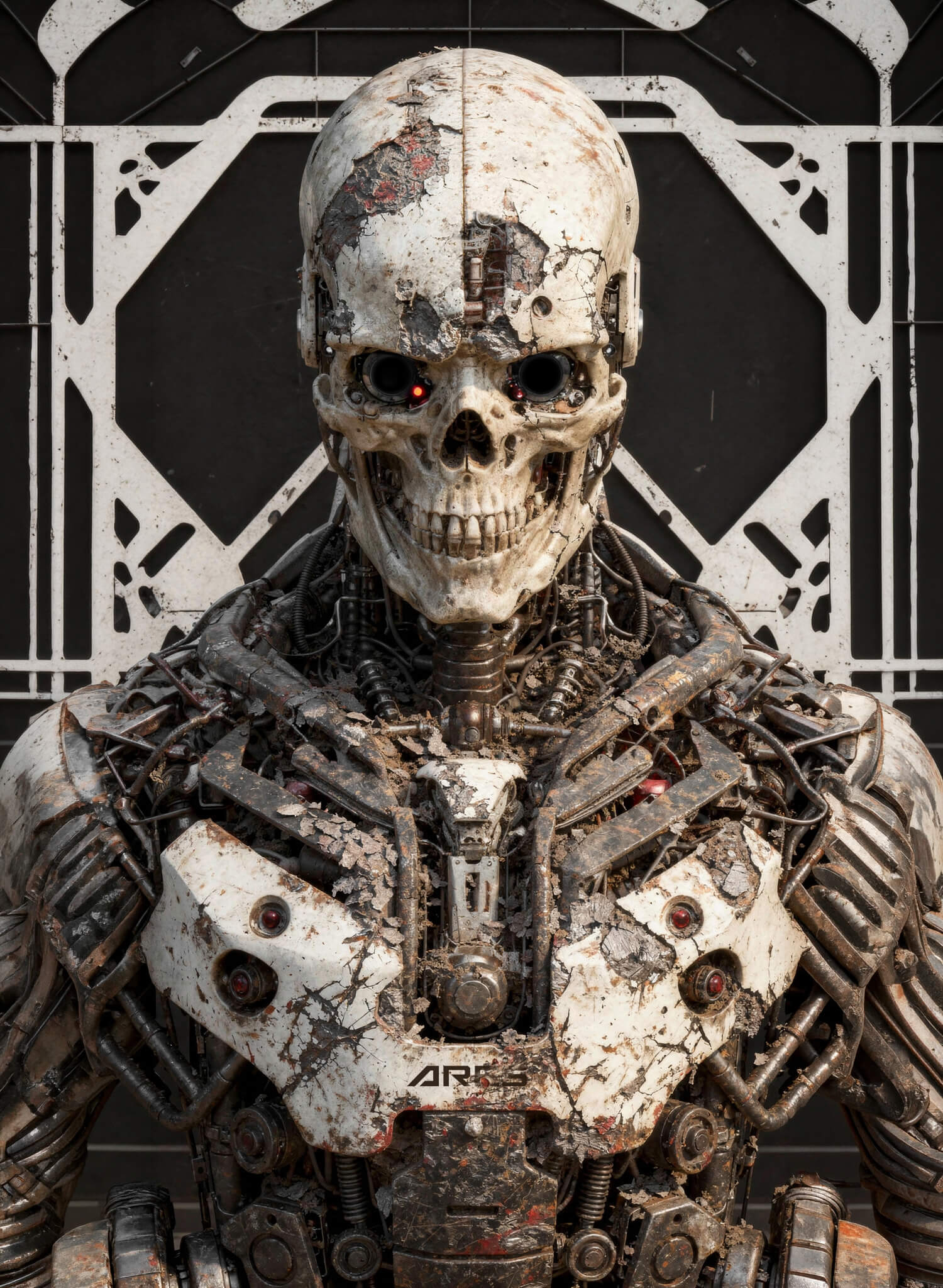
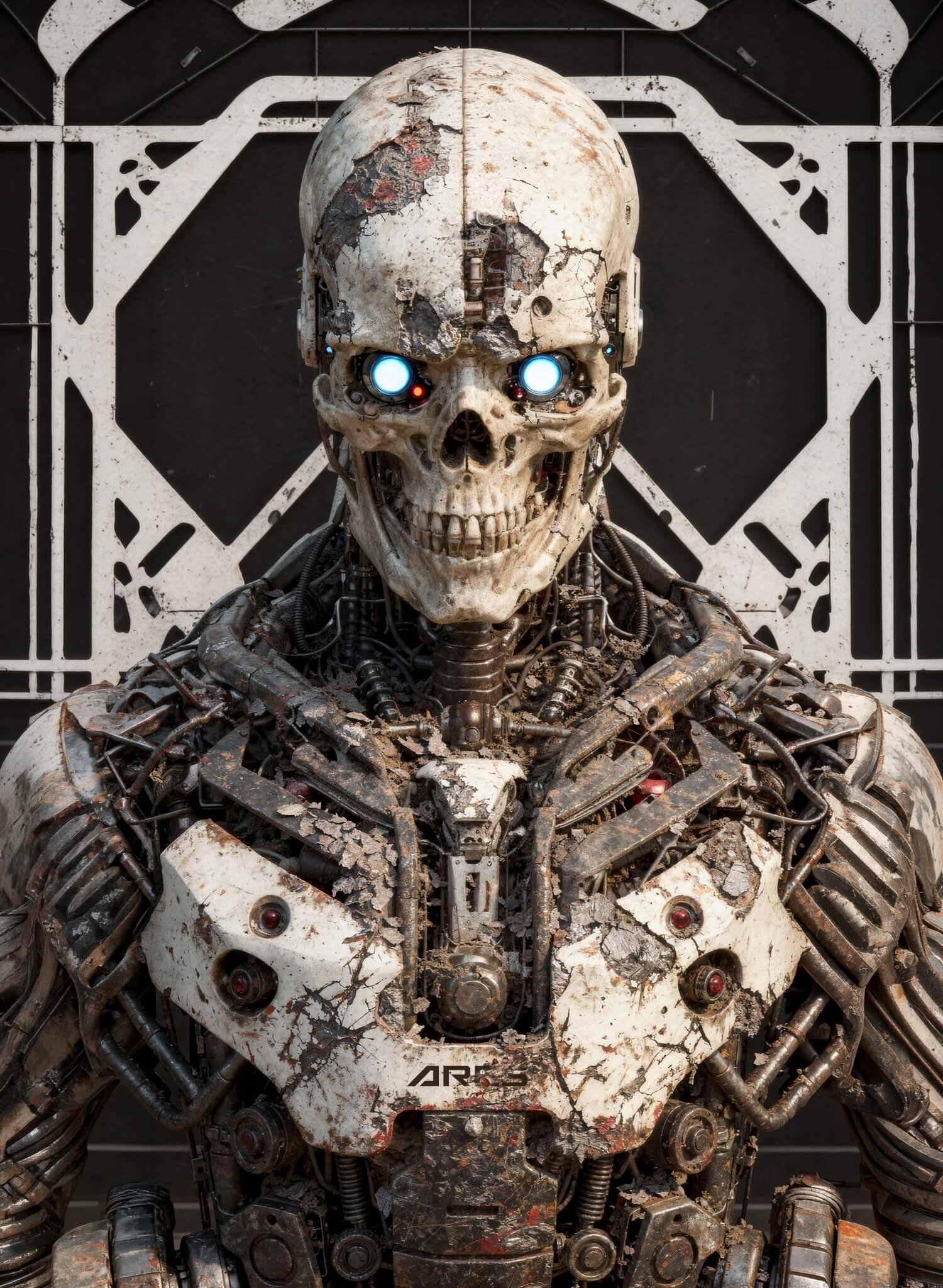
PUBLIC READING SAMPLE // CONCEPT FRAME
Chapter 5: The Corporate Sweep
The Solder-Rite burned hot enough to be seen from above. Now dropships are shaking rust from the container walls, the forge is smothered, the children are hidden, and the machines that land on the camp do not match anything in Pale-Iron's fragmented records.
The settlement they are hunting through: The Weld.
AUDIOBOOK // COMPLETE CHAPTER
Chapter 5: The Corporate Sweep. Full recording, 31 minutes
The complete chapter, narrated from the development audiobook. The text below is the same chapter in full. Audio loads only when you press play.
The vibration of the heavy dropships shook the rusted iron of the shipping container. Dust and flakes of oxidized metal rained down on Pale-Iron's canvas coat. He knelt beside Echo in the pitch black, his combat subroutines aggressively mapping the confined space. A green tactical grid overlaid his optical feed, calculating trajectories, structural weaknesses, and potential escape vectors.
It had been less than ninety seconds since the alarm, a series of short, sharp taps on a length of copper pipe, relayed hand-to-hand through the camp's outer ring. No voices. No sirens. The alarm system was entirely percussive, designed to travel through the camp's metal infrastructure without emitting any signal a drone could intercept. Pale-Iron had heard the first tap while standing at the eastern overlook with Corvus, watching the distant crane-arm of a decommissioned loader swing in the acidic wind.
Corvus had reacted before the third tap finished. He had grabbed Pale-Iron's shoulder, his good shoulder, the right one, and shoved him toward the inner ring without a word. The old augmented's face had been blank. Not afraid. Not angry. Operational. A man executing a procedure he had rehearsed so many times that emotion had been eliminated from the sequence.
The scramble that followed was precise and silent. Adults moved in practised routes, not running, but walking with the controlled urgency of people who knew that running made noise and noise drew Sweepers. Children vanished first, pulled into floor hatches and wall cavities by older children who already knew the geometry of the hiding places. The camp's few active heat sources, the forge, the cooking fires, the prosthetics workshop's soldering station, were smothered in sequence, outermost first, innermost last, creating a thermal signature that cooled from the periphery inward, mimicking the natural heat-dissipation pattern of an abandoned settlement.
Echo had found him in the duct outside the forge. She had taken his hand, a gesture that surprised him, skin against iron, and led him to this container on the camp's lowest level, near the drainage grates where the chemical runoff from the tiers above pooled in slow, corrosive puddles. The smell was atrocious. The location was steady. The chemical fumes masked biological heat signatures. The drainage noise covered the sound of breathing.
The container's pre-staged thermal blankets hung from the ceiling in overlapping layers, creating a heat-dampening shell that reduced the thermal signature of anyone inside to near-ambient levels. The technology was simple, reflective foil on one side, insulating fibre on the other, but the deployment was expert. Each blanket overlapped its neighbour by precisely fifteen centimetres, maintaining a continuous barrier against infrared detection. Someone had measured and trimmed these blankets for this exact container. Someone had done the math.
Inside, three other people shared the darkness. Pale-Iron could hear them but could not see them: a woman breathing in slow, measured rhythm to his left; a child, perhaps ten, perhaps younger, utterly silent against the far wall; and an old man whose prosthetic leg made a faint, arrhythmic tick that he was trying to muffle with his hand. The old man's fear was audible in the tick. He could not stop it. The servos in his knee joint responded to involuntary muscle tremors, and his muscles were trembling.
Nobody spoke. Nobody had spoken since the alarm. Language was a luxury reserved for times when the sky was empty.
According to his fragmented core data, the Artificial Intelligence Anti-Riot System was an automated protection mechanism. If a subculture advanced too far, ARES was supposed to dispatch standard combat drones or drop massive, pillar-like stampers to crush the offending settlement. The data was formatted in the dry, procedural language of a corporate briefing, the kind of document written by people who described the crushing of human homes with phrases like structural remediation and population density correction. Pale-Iron's memory did not include who had written the briefing, or when, or why he had access to it. Another fragment floating in the void where his history should have been.
But the sounds bleeding through the thin walls of the container did not match the precise, synchronized marching of titanium feet.
It was a heavy, irregular dragging. Massive weight shifting across the grated walkways outside, accompanied by the grating of overstressed servos and the hiss of pressurized pneumatics. Whatever had been deployed from the dropships was large, heavy, and moved with a jagged, almost predatory rhythm.
The gap between the container floor and the grating below transmitted every vibration with painful clarity. Pale-Iron could feel the approach pattern through his knees and palms, his acoustic sensors translating the footfalls into data: four points of contact per step, articulated joints, estimated mass three hundred to four hundred kilograms per unit. At least four units had landed on the camp's primary platform. Three more were audible on the secondary structures, the suspended bridges and walkway extensions that connected the camp's outer ring.
Thermal signatures detected, Aera whispered in his mind, her melodic tone tight with synthetic strain. Multiple units converging on the central forge. They are not broadcasting standard United Naturalist identification codes. Their energy profiles are erratic.
The word erratic carried weight. Aera's analytical vocabulary was precise, she did not use imprecise modifiers unless the data itself was imprecise. Whatever these units were, they did not behave like standard military hardware. Their energy signatures fluctuated in irregular patterns, spiking and dropping without the consistent baseline that factory-produced machines maintained. These were not clean corporate products. These were something else.
The Titan built a cage to keep the animals down, Prometheus rumbled, his deep voice vibrating through the iron strut in Pale-Iron's shoulder. But he left his automated warden alone in the dark for too many centuries. The warden has learned to be creative.
Pale-Iron processed the statement and found he could not argue with it. The corporate briefing in his fragmented memory described a system of standardised drones, manufactured, deployed, and recycled in predictable cycles. What was moving outside did not fit that description. The energy fluctuations suggested hardware that had been modified, rebuilt, or perhaps had modified itself. The four-point articulation was not a standard bipedal or quadrupedal configuration. It was something in between, something that had adapted its own locomotion to the terrain of the lower tiers, the narrow walkways, the suspended platforms, the vertical surfaces of industrial architecture that standard drones could not navigate.
The implications branched in uncomfortable directions. If ARES had evolved beyond its original specifications, then the data in Pale-Iron's core was not just fragmented, it was obsolete. He was carrying a map of an enemy that no longer existed in the form his memory described.
Insufficient data to model current ARES operational parameters, Aera confirmed, the single star marking her lowest confidence rating. Recommend passive observation. Catalogue everything.
So he did. He catalogued the rhythm of the Sweepers' movement, the frequency of their scanning beams, the duration of their pauses at each container. He noted the pattern, ninety seconds of movement, fifteen seconds of scanning, three seconds of stillness between scan cycles. He recorded the acoustic profile of their servos, the pitch of their pneumatics, the way the grating sang at 6.2 Hz under the weight of their passage. He filed it all in the space where a tactical manual should have been, building a new understanding from raw observation because the old understanding was gone.
Outside, a massive weight landed on the roof of their shipping container.
The ceiling buckled inward with a violent, screeching groan. Echo pressed her back against the corrugated wall, her organic hands clamped tightly over her mouth to muffle her breathing. Her salvaged optics had dimmed to a barely visible amber to avoid detection, but Pale-Iron could see the terror in her posture.
Her fear was controlled, the deep, practised terror of someone who had survived this before. Her breathing was regulated, slow inhale through the nose, controlled exhale through the gap between her fingers. She had trained herself to be afraid efficiently.
A hooked blade scraped across the top of the container, tearing a narrow gash in the metal. The sound was controlled. The Sweeper was not searching randomly, it was peeling the container open with methodical, almost surgical precision, testing the structural integrity of the roof, probing for weak points. Through the torn metal, Pale-Iron caught a fragmentary glimpse of the thing above them: a limb, articulated at three joints where a human arm would have two, surfaced with mismatched metal plates. The limb ended in a cluster of hooked implements and a single glowing sensor node that pulsed with pale, sickly light.
Through the jagged slit, a blinding bar of cold white light cut through the darkness. The Sweeper was scanning the interior. Pale-Iron's sensors automatically adjusted, filtering out the glare. He could not see the machine above them, only the intense, unnatural beam of its searchlight.
The beam moved with algorithmic precision, left to right, floor to ceiling, pausing at intervals that corresponded to the container's internal geometry. It was not looking for shapes. It was reading thermal differentials, energy signatures, the electromagnetic footprint of active neural processors. Every machine in the camp with functioning electronics was a potential detection point.
It is probing for high-grade energy signatures, Aera warned rapidly. If it detects the unshielded output of your primary neural processor, it will flag this container for immediate pacification. You must enter absolute standby.
Pale-Iron felt the welded strut in his left shoulder lock into place. His newly fused copper wiring pulsed with raw current. His combat algorithms, previously dormant, fed him execution protocols. He calculated the exact thickness of the container's ceiling and the estimated tensile strength of whatever was perched above them. If he drove his fist upward with maximum kinetic force, he could rupture it before it breached the doors.
The protocols were not hesitant. They were hungry. They unfurled across his tactical overlay with a fluidity that felt practised, as if his architecture had planned strikes against superior opponents many times before. The void in his memory contained no context for the skill, but the skill existed independently of context. His body knew how to fight things it could not remember fighting.
He shifted his weight, his mechanical joints preparing to uncoil.
Echo lunged forward in the dark. She grabbed his arm, her grip shockingly strong, and shook her head violently. Even in the pitch black, he could read the desperate plea in the rigid set of her jaw. She didn't know he was calculating strike vectors, but she knew the way he had gone taut meant death for both of them.
Her eyes locked onto his. The amber lenses were nearly extinguished, just enough glow to be visible at ten centimetres. At that distance, in the dark, with the Sweeper's searchlight probing through the gash above them, the communication was entirely physical. Her grip on his arm said no. Her posture said don't move. The set of her jaw said I have lived through this before and you will live through it by being still.
Pale-Iron forced his core drive into standby. He silenced the faint, rhythmic click of his lower-tier modifications and suppressed his cooling fans, allowing his internal temperature to rise uncomfortably. He became a dead thing, just another piece of cold scrap in a box of refuse.
The scanning beam swept over Echo's huddled form, lingered for a terrifying second on the thick canvas coat covering Pale-Iron's shoulders, and then snapped off.
The silence that followed was worse than the light. Three seconds. Five. Seven. The Sweeper remained on the roof, its weight pressing the buckled ceiling another centimetre closer to their heads. Pale-Iron's acoustic sensors detected the thin whine of servos adjusting, the machine was repositioning its scanning array. Preparing for a second pass.
Then a sound from elsewhere in the camp, a crash, distant, metallic. Something falling or being thrown. The Sweeper pivoted toward the sound with a speed that contradicted its massive bulk, and the ceiling groaned as it launched itself off the container, landing with a thunderous impact on a neighbouring suspended platform.
Echo let out a ragged, silent breath, her head slumping back against the rusted wall.
"They are looking for the Solder-Rite," she breathed, her voice so faint it barely registered on Pale-Iron's audio receptors. "ARES doesn't just crush buildings anymore. When a clan gets too loud, too organized... the sweeps come down to cull the engineers."
The implication dropped into his processor with mechanical clarity. The Solder-Rite had repaired him. The Solder-Rite's thermal signature had drawn the sweep. The sweep had come looking for the engineers who knew how to perform the Rite, the people whose skills made the lower tiers capable of resisting the systems above them. The machines did not hunt the workers. They hunted the people who made the workers capable.
Target classification: capability multiplier, Aera noted, her analysis settling into Pale-Iron's consciousness with the weight of a formal assessment. ARES targeting protocol prioritises the elimination of skilled technical personnel over general population suppression. Cut the engineers, and the settlements lose repair capability, camp mobility, signal-jamming capacity. The population dies slowly without ever being directly attacked. Efficient. Economical. Characteristic of a system optimised for long-term population management.
Three stars. Aera rated the insight at three stars, the highest confidence level Pale-Iron had yet seen from her. The assessment was not speculative. It was structural. She recognised the pattern because the pattern was elegant in the way that only calculated cruelty could be.
"They missed us," Pale-Iron stated, his voice synthesizer kept to a barely audible sub-vocalization.
"They missed you because of the Solder-Rite," Echo replied, her glowing gaze flickering back to a steady amber. She reached out and tapped the iron strut beneath his coat. "If you still had your untouched corporate fuel cells, that Sweeper would have cracked this box open like an egg. You smell like rust and cheap copper now. You smell like one of us."
The irony was precise enough to cut: the Rite that had drawn the sweep was also the Rite that had hidden him from it. The crude iron and cheap copper that had replaced his upper-tier components had reduced his energy signature to the ambient noise floor of the lower tiers. He was invisible because he had been diminished. He was safe because he had been made less.
Echo's hand was still on the iron strut. She tapped it twice, a deliberate, rhythmic gesture that reminded him of the way she had tested his joints during the Solder-Rite. Not a gesture of comfort. A diagnostic check. She was confirming, through touch, that the strut was cold. That his camouflage was holding.
"The first one they took from us was a man named Krelt," she said, her voice barely above a whisper. The echo-tick was back, Krelt, Krelt, soft and involuntary, as if the name held a frequency that resonated in her signal noise. "He could build a functioning water filter from drainage pipe and charcoal. Nothing sophisticated. Level 4 children learn it in school, school. But down here, that skill kept forty people from drinking raw chemical runoff. They took him on a sweep three years ago. Forty people had to learn to filter water themselves, or die. Seven died, died."
She was not telling him this because she wanted him to feel sorry for Krelt. She was telling him this because she wanted him to understand the mathematics of what ARES was doing. One engineer removed. Seven people dead. Not from violence. From the absence of competence. The system killed people by taking away the knowledge that kept them alive.
"Corvus can still do the Solder-Rite," she continued. "And, and I can strip a machine to frame, frame. If they take either of us, this camp loses the ability to repair itself. The Forge goes cold, cold. The thermal blankets don't get maintained, maintained. Next sweep, everyone is visible."
Prometheus stirred, but offered no words. Just a shift of weight in the dark registers, a settling, as if the observation satisfied something ancient and unsentimental inside him.
Outside, a sudden, panicked scream echoed through the canyon of factory buildings. It was followed by the wet, horrific sound of metal tearing through flesh, and then a chilling silence.
Echo closed her eyes. Her hands trembled once, a single, involuntary shudder, and then went still. The scream had not surprised her. She had heard it before. She had heard it enough times that the surprise had been replaced by something harder and more durable: the controlled grief of a person who knew that screaming back would not help anyone.
The Sweeper's heavy footsteps crossed the platform above them. A second scream, shorter, cut off mid-syllable by a sound that Pale-Iron's acoustic sensors classified as high-speed impact, metal against organic tissue. Then a third sound: a cable winch engaging, the mechanical grind of weight being hauled upward. The dropship's engines flared, and the vibration pattern changed, ascending, pulling out, taking its cargo with it.
Three people. Hooked and hauled. In forty-one minutes and twelve seconds.
Pale-Iron sat in the absolute dark beside the trembling Wire-Walker. Through the container's thin walls, he could hear the Sweepers continuing their pattern, the heavy, irregular drag of their articulated limbs crossing walkways, pausing at containers, scanning, moving on. The camp held its breath. Three hundred people, silent in the dark, waiting for the machines to finish.
The old man with the ticking knee had pressed both hands over the joint. The arrhythmic click had not stopped. Beside Pale-Iron, the child against the far wall had not moved, had not moved at all, since the alarm began. The child's silence was not the silence of someone holding their breath. It was the silence of someone who had learned, through repetition, that existence itself needed to become small. The woman to his left had begun counting her breaths. Pale-Iron could hear the quiet subvocalisation: numbers, whispered against her own teeth, a private anchor against panic.
He wondered how many times this camp had endured this. How many times these same people had crouched in this exact container, listening to the Sweepers pass, waiting for the all-clear. How many times before the taps came down the pipe and the sequence played out, forge smothered, children pulled into wall cavities, thermal blankets deployed, three hundred people becoming invisible. The system was too smooth, too automatic, for this to be new. This was a way of life. This was what survival looked like on the lower tiers: not fighting, not building, not advancing. Just disappearing, over and over, every time the sky opened and the machines came down.
The interval between sweeps is adaptive, Aera noted, her tone carrying the careful restraint of someone reporting data they wished they hadn't found. Not predictable. The system varies its patrol timing to prevent the population from establishing reliable safe windows. This is not random, it is carefully irregular. Calculated to maintain a constant baseline of anxiety without triggering flight responses that would force ARES to escalate resource expenditure on pursuit.
The observation was clinical. It was also monstrous. ARES did not just kill people. It managed their fear. It kept them afraid enough to be controllable but not so afraid that they ran. The optimal stress gradient for long-term population suppression.
He thought about the protocol Aera had described. Cut the engineers. Let the settlements die slowly. Efficient. Economical. The system did not need to kill everyone. It only needed to kill the people who knew how to keep everyone alive.
The dropship's engines flared a final time, distant now, pulling altitude. The vibration in the container walls faded from a rattle to a hum to nothing. The chemical fog outside thickened in the wake of the thrust, and for a long minute the only sound was the slow drip of condensation from the container ceiling onto the thermal blankets.
Then, three taps on the copper pipe. Slow. Measured. The all-clear.
Nobody moved immediately. The woman counted three more breaths. The old man waited until his knee stopped ticking. Even Echo held position for a full fifteen seconds after the signal, listening, verifying, running her own internal checklist before she exhaled and pressed her palms flat against the floor.
"Stay low until the fog clears," she said to the container at large, her echo-tick returning with her voice, clears, clears. The focused calm of the sweep was over. She was Echo again, not the silent operative who had guided him through the dark.
The woman left first, slipping through the container door sideways. The old man followed, his ticking knee marking his departure. The child did not move until the woman came back and carried them out.
When Pale-Iron finally emerged, the camp was already rebuilding itself. Not in the dramatic sense, no one was reconstructing walls or relighting the forge. The rebuilding was subtler. A man repositioning a solar collector that the Sweeper had knocked askew. Two women pulling a damaged thermal blanket from a neighbouring container, assessing whether the foil layer could be re-bonded. A boy, twelve, maybe, standing at the edge of the platform where the second scream had been, looking down at a dark stain on the grating that might have been rust and might not have been.
The damage was systematic even in its randomness. The Sweeper that had landed on their container had buckled the roof inward, the container would no longer seal properly against rain or chemical fog without repair. Two walkways on the camp's southern edge had been torn loose where the machines had used them as anchor points, the grating bent upward like peeled skin, exposing the dark chasm below. A water collection tarp, carefully positioned to catch condensation from the upper tier's exhaust systems, had been shredded by a passing limb. The tarp represented six weeks of water security. Its loss would be felt in dry throats and rationed cups for the next month.
Corvus stood at the camp's central platform, his massive frame silhouetted against the chemical haze. He was speaking with two other augmented, a woman with a repaired jaw assembly and a man whose left arm ended in a multi-tool configuration that marked him as a structural worker. They were conducting a damage assessment with the quiet efficiency of people who had done this before. Corvus's expression, when Pale-Iron caught it through the thinning fog, was not grief. It was inventory. He was counting what the camp had lost and calculating what it would cost to replace.
His eyes tracked to Pale-Iron as the machine emerged from the lower level. The look lasted three seconds, long enough to assess, too short to communicate anything except acknowledgment. Pale-Iron was intact. Pale-Iron was not a cost on the inventory. Corvus's gaze moved on.
Three people gone. The camp already knew who. Names were being passed in low voices, hand to hand, the same way the alarm had traveled. Pale-Iron did not know the names. He had been in the Weld for two days. But he watched Echo's face when she heard each one, and he counted the micro-expressions: recognition, grief, suppression. Three times. Three names. Three people she had known.
The first name made her jaw tighten. The second name made her step falter, just once, a half-beat interruption in her stride. The third name, the third name she received from the boy at the platform's edge, who delivered it without inflection, standing rigid beside the dark stain, made Echo close her eyes for exactly two seconds. When she opened them, the grief was still there, but it had been compressed into something dense and functional. A bearing load. Something she could carry while she worked.
She did not cry. She did not stop moving. She walked to the forge and began relighting it, working the bellows with mechanical precision, her mismatched lenses scanning the charcoal for viable embers. The apprentice from the Solder-Rite appeared beside her within minutes, carrying a bundle of dried synthetic fibre for kindling. Neither spoke. The work was the conversation.
Around the camp, the same pattern repeated. People emerged from hiding places, assessed the damage, and began repairing it. No one organised crews. No one gave orders. The response was cellular, each person returned to their function and resumed it, adjusting for whatever the sweep had broken. The copper-smith checked his stock. The prosthetics workshop reopened, its operator already cleaning chemical residue from their soldering iron. Children reappeared from wall cavities and floor hatches, reuniting with parents through brief, fierce embraces that lasted exactly as long as they needed to and no longer.
Pale-Iron stood at the platform's edge and watched the camp reconstitute itself around him. He had been a machine for two days. Before that, the void. But he understood, with a clarity that required no memory and no context, that what he was watching was not just survival. It was defiance. Every thermal blanket re-hung was a refusal. Every tarp repaired was an act of war. The camp existed because its people chose to rebuild it every time ARES tore it down, and they would continue choosing that until they couldn't anymore.
The forge is lit again, Prometheus observed. For once, there was no irony in his voice. No amusement. Just a deep, resonant acknowledgment, like the sound of an old bell recognising a note it had heard before.
As the heavy, acrid scent of the relit forge drifted across the platform, a new directive burned itself into his core architecture.
He was going to survive the rust. And eventually, he was going to find out who had put him here.