PUBLIC READING SAMPLE // CONCEPT FRAME
Chapter 3: The Solder-Rite
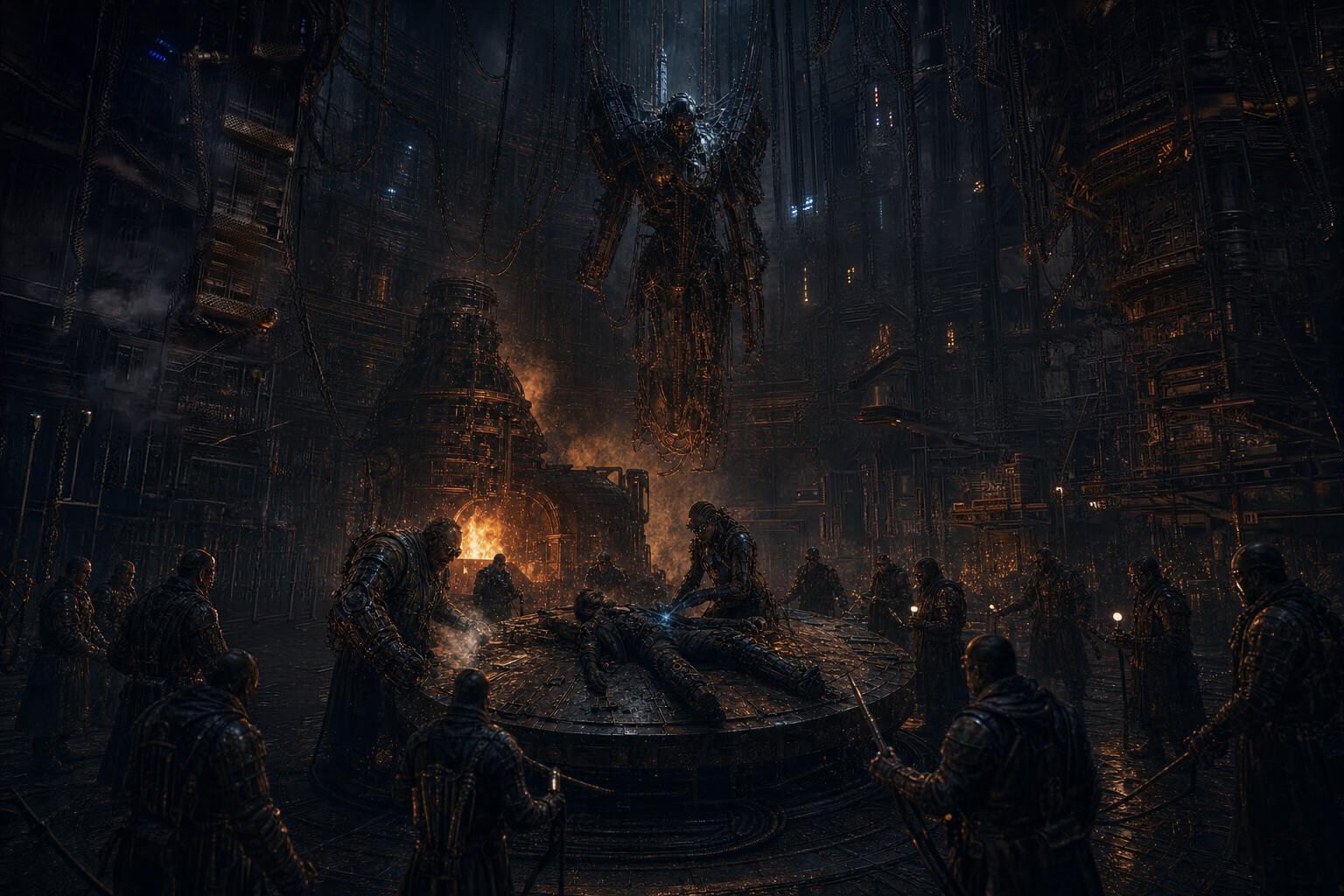
The rail-sled has reached the Weld, a settlement suspended between structural pillars, hidden from the sensors above. Echo carries her four-hundred-kilogram stranger toward the anvil, where the Railmakers perform the rite that gives this book its name.
The chapter that brought them here: The Rail-Sled.
AUDIOBOOK // COMPLETE CHAPTER
Chapter 3: The Solder-Rite. Full recording, 27 minutes
The complete chapter, narrated from the development audiobook. The text below is the same chapter in full. Audio loads only when you press play.
The walk to the center of the settlement was a blur of failing optics and grinding joints.
Echo carried most of his weight, her power suit whining under the burden. As they moved deeper into the suspended shantytown, the dense upper-strata fog gave way to the stifling, dry heat of the camp. The air here was different. It still tasted of sulfur and synthetic fuel, but it was alive with the smell of roasting meat, melting flux, and the sharp tang of ozone.
The walkway beneath them was built from layered grating, at least three thicknesses of steel mesh, welded together and bolted to cross-beams at half-metre intervals. The construction was overkill for pedestrian traffic, but Pale-Iron's sensors registered his own weight at four hundred and twelve kilograms. The grating flexed beneath each step, and the bolts nearest his feet creaked with a sound that suggested they had been calculated for exactly this kind of load. The camp had been built to carry heavy metal. Wire-Walkers did not rescue lightweight machines.
Heat rose from below in irregular waves, thermal plumes from the furnace exhaust, radiating outward through the camp's infrastructure. The temperature gradient was disorienting. Three steps in one direction dropped the ambient reading by two degrees. Three steps in another raised it by five. The walkways closest to the furnace were uncomfortably hot even for the augmented workers, their surface metal darkened by persistent thermal stress. The walkways at the camp's periphery were cold enough to frost.
Pale-Iron's thermal regulation system was failing. His damaged left side leaked thermal fluid in a slow, continuous drip, and the lost coolant left his core temperature unstable, oscillating between the critical-low readings of his compromised power systems and the sudden, scorching heat of the forge district. His internal display strobed amber warnings with every fluctuation. Echo watched the warnings through his exposed chest cavity, she could read the diode pattern without needing to access his diagnostic feed. She had learned to read machines the way a medic read vital signs: from the outside, through the symptoms that the body couldn't hide.
The Railmakers parted to let them through. There was no chaotic scrambling. The inhabitants of this vertical graveyard moved with controlled, synchronized grace. Pale-Iron watched them through flickering crimson sensors. Draped in thick fabrics and scavenged armor plating, their bodies were a testament to a lifetime of brutal labor. Many sported mechanical prosthetics that hissed and clicked in the perpetual gloom.
He counted them as they passed. Two hundred visible adults, maybe more in the containers behind closed doors. Perhaps three dozen children, visible in glimpses, a face in a container doorway, a small hand pulling a cable spool, a pair of legs dangling from the underside of a walkway where someone had made a hiding place from bent sheet metal. The adults ranged from heavily augmented Juggers in full power harnesses to lightly modified workers in thermal wraps whose modifications were nearly invisible, a sub-dermal antenna ridge behind one ear, a single replacement fingertip, a darkened patch of skin where conductive mesh had been implanted beneath the surface.
The social order was visible in the positions they held. The most augmented worked at the camp's structural periphery, maintaining anchor clamps, repairing the suspension cables, operating the signal jammers that hid the settlement from the sensor grids above. The lightly modified worked inward, at the market stalls and food preparation stations. At the very center, near the anvil, the division collapsed entirely. Here, augmentation was irrelevant. What mattered was skill.
As Echo guided him past the iron tents, individuals reached out. They did not grab or claw. They simply let insulated gloves graze the intact synthetic weave of his right shoulder or tap the exposed cold steel of his ruined left side. It was a tactile greeting, a physical acknowledgment of shared existence in a broken world. An older woman with a thermal apron touched the copper wiring spilling from his chest and whispered something in Rust-Tongue that his language processor struggled to decode, the inflection was unfamiliar, the vowels stretched into tones that carried emotional weight his algorithms had no register for. Whatever she said, Echo's jaw tightened slightly.
A young man, organic, not augmented, with the lean build of a runner and chalk marks on his forearms, fell into step behind them. He carried a heavy tool roll over one shoulder and a chemical lantern that cast a warm, amber glow across the walkway. He did not introduce himself. He simply followed, as if his presence at the Rite was assumed.
"Bring him to the anvil," Echo commanded, her voice cutting through the ambient roar.
The anvil was not a blacksmith's block, but a massive slab of reinforced titanium salvaged from the hull of a fallen corporate dropship. It sat directly beneath the largest scrap effigy and adjacent to a roaring deep-smelting furnace. The radiating heat was staggering, but for Pale-Iron, whose core temperature was critically low, it felt like a sudden, overwhelming embrace.
The slab's surface told a story. Decades of welding had left overlapping arcs of discolouration across the titanium, burn marks in concentric spirals, each one the ghost of a previous Rite. Some were recent, the metal still darkened and rough. Others had been polished smooth by time and contact, their edges softened into the surrounding surface. The anvil had held hundreds of bodies. The history of every repair the Weld had ever performed was written into its scorched metal.
Around its base, the grating had been reinforced with crossbeams of heavy-gauge steel, welded at right angles into the platform's substructure. The anvil was the single heaviest object in the camp. Its weight had been designed into every load calculation, every suspension adjustment, every anchor point. When the camp moved from pillar to pillar, the anvil moved with it. It was the axis around which the Weld rotated.
Corvus was already there, his hydraulic pincer venting steam as he cleared the titanium slab of loose tools. Several other Railmakers gathered around the perimeter, their faces illuminated by dancing orange flames. They carried industrial welding torches, thick spools of braided copper, and rough soldering irons that looked like weapons. The young runner with the tool roll took his position to Corvus's left, unrolling the canvas with a single practised flick to reveal a set of hand-forged surgical implements, tongs, clamps, probes, and a curved aspirator made from repurposed medical tubing. The tools were crude, but each one had been shaped for a specific purpose and honed to a specific edge. They had been used before.
"Lay him flat," Corvus grunted, narrowing his gaze as he assessed the catastrophic damage. "If his internal gyroscope is as warped as his shoulder, we need him perfectly level before we cut the power."
Echo eased him backward onto the slab. The metal was incredibly hot against his exposed ribs, sending a cascade of thermal warnings across his internal display. He stared up at the ceiling of smog, watching toxic rain vaporize against the invisible dome of the signal jammers.
"I am going to power down your primary motor functions," Echo said. She leaned over him, her glowing mechanical gaze locking onto his. She did not wear the sterile white coat of an upper-tier technician; her hands were stained with grease and carbon scoring. "Your digital brain will remain active. You'll see us, and hear us, but you won't be able to move. Understand?"
Pale-Iron tried to nod, but his neck servos merely ground together. "Will it... will the void return?"
"No," Echo said softly, her thumb brushing sediment from his cheek. The gesture was slower than it needed to be, her calloused skin tracing the line where synthetic weave met exposed steel. "The void is for the empty ones." Something passed behind her amber lenses, a distance that had nothing to do with the forge or the slab or the sparking capacitors. Her jaw tightened. When she spoke again, the words came back steady. "We are going to fill you up."
Her voice had changed. The echo-tick, the half-beat loop that doubled her syllables, was absent. The words came out clean, singular, each one placed with measured weight. When she was focused on technical work, truly focused, her attention narrowed to the width of a wire, the repetitions vanished. The stutter was not a flaw. It was ambient noise, the part of her that listened to too many signals at once. When the signals collapsed to one, her voice was still.
She reached into the torn cavity of his chest. Her bare fingers, the gloves were off now, stripped for precision, moved through his architecture with the confidence of someone who understood what she was touching. Not the way an engineer understood a schematic, but the way a body understood another body: by feel, by heat, by the particular resistance of living circuitry under living skin.
She paused. Her fingertips rested against a junction point deep in his chest, a cluster of neural pathways converging on a sealed module that Pale-Iron's own diagnostics could not access. The module was not software. It was hardware — a physical housing built into the chassis itself, separate from the encrypted memory sectors, separate from the firewall that hid whatever he had been before the void. This was something else. Something embedded at the fabrication level, sealed shut by design, not by damage.
Echo's fingers explored its casing gently, tracing the smooth, seamless edges.
"This one's sealed," she said low, half to herself. "Not encrypted. Physically sealed. I've never seen this alloy before."
She withdrew her hand from the module without attempting to open it. Whatever professional curiosity she felt was overridden by a more immediate calculus: you don't breach a sealed housing during emergency repair. You note it. You come back.
She found the manual override switch seated near the base of his spine. With a swift, practiced motion, she twisted it.
The paralysis was instantaneous. The low hum of his internal drive died completely. The piston-like rise and fall of his chest ceased. He was trapped in a state of absolute stillness, a conscious ghost locked inside a dead machine.
The silence inside his skull was vast. Without his motor functions generating background noise, the tick of servos, the whisper of cooling fans, the rhythmic pulse of his core drive, his audio receptors became hyper-sensitive. He could hear the individual crackle of each flame in the furnace. He could hear the slow drip of thermal fluid leaking from his damaged left side, each drop hitting the titanium slab at precise, metronomic intervals. He could hear the breathing of every Railmaker standing within five metres, the ragged, chemical-scarred respirations of workers whose lungs had been fighting toxic air for decades.
And beneath it all, he could hear the camp itself. The low groan of suspension cables under load. The tick of cooling metal as the furnace temperature fluctuated. The faint, almost imperceptible vibration of the platform as it absorbed the movements of every living being on its surface. The Weld was not silent. It breathed. It shifted. It held.
Warning. Primary motor functions offline. Defensive capabilities nullified. Aera's voice moved through his processor, stripped down to data. Third-tier tools. Primitive heat-fusion. Crude alloy bonding. By all logical metrics, this should destroy your remaining infrastructure.
Watch them, Aera, the deep rumble of Prometheus echoed from the darkest sectors of his mind. These insects survive in the venom of the forge. Watch what they do with the scrap of gods.
It was the first time the presence had addressed Aera directly. The first time it had used words instead of weight. Pale-Iron filed the shift automatically: whatever lived in his deep registers, it was choosing to speak now. Choosing its moment. The Rite had drawn it out.
The Solder-Rite began not with the cut of a laser scalpel, but with a rhythm.
Corvus struck a broad iron wrench against the side of the titanium slab. A dull, resonant clang echoed through the camp. Another Railmaker struck a nearby steel pillar. Then another. Soon, the entire perimeter was filled with a slow, synchronized, metallic heartbeat that vibrated through the slab and directly into Pale-Iron's cold steel frame.
The rhythm built in layers. The camp itself was an instrument, and the Railmakers played it with the unconscious mastery of musicians who had been performing this piece since childhood. Pale-Iron's acoustic sensors registered the fundamental frequency: 4.3 hertz. Lower than a human heartbeat. The frequency of load-bearing steel under optimal tension.
The young runner crouched beside the slab, holding the chemical lantern close to Pale-Iron's exposed chest cavity. His face was serious, concentrated, the chalk marks on his forearms glowing amber in the lantern light. He reached into the tool roll and selected a pair of copper-tipped forceps, passing them to Echo without being asked. He was an apprentice. He had done this before.
Echo raised a welding torch. The flame ignited with a blinding blue hiss.
She brought the fire down to his ruined shoulder. Because his motor functions were severed, he could not flinch, but his virtual nervous system registered the extreme heat. It was terrifying. The concentrated inferno softened the jagged steel at the edge of the wound. Corvus stepped in, using his hydraulic pincer to force a thick, scavenged iron strut into the hollow of Pale-Iron's shoulder joint, replacing the shattered kinematic piston.
The strut was not a precision part. It was a rough-forged bar of lower-tier iron, its surface dimpled with hammer marks and black with carbon from the furnace. Under magnification, Pale-Iron's sensors could see the grain structure, coarse, crystalline, nothing like the nanostructured alloys of his original architecture. It was the metallurgical equivalent of patching a silk shirt with canvas. But Corvus seated it with an accuracy that belied the tool's crudeness, finding the exact angle of the original joint, aligning the load paths, matching the pivot geometry within a margin that Pale-Iron's internal diagnostics flagged as acceptable.
Ninety-four percent alignment with hand tools and a hydraulic pincer. By feel.
As the blue flame fused the upper-tier steel with the lower-tier iron, Echo began to chant. Her voice wove seamlessly into the metallic heartbeat of the clan. She spoke in Weld-Cant, the ritual register of the old Jugger Rust-Tongue, a language of technical schematics fused to spiritual reverence. She asked the rust to hold. She asked the circuit to close.
The words were not prayers. They were instructions, addressed to the material itself, as if the iron and copper were sentient participants in the procedure. The Weld-Cant terminology mixed technical terms with kinship language: the strut was asked to bear the way a parent bears a child. The copper was asked to flow the way a river flows to sea. The solder was asked to bind the way a vow binds a speaker. Every technical action had a relational equivalent, and Echo spoke both registers simultaneously, her voice moving between calibration and ceremony without pause.
Another Railmaker leaned over his chest, unwinding a spool of thick copper wire and weaving it through the burned-out structure of Pale-Iron's neural pathways, bypassing his crushed fuel cells and routing power directly from an external battery pack bolted to the slab.
Temperature stabilizing, Aera whispered. Core power returning to nominal levels. They are bypassing encrypted safety protocols with raw analog current. Reckless. Effective.
The rhythmic striking of metal against metal grew faster, matching the rising hum of the battery pack. The heat from the welding torch bathed Pale-Iron's vision in beautiful blue light. He felt the liquid metal cooling, binding his broken halves together. The rough iron strut locked into place, merging with his advanced servos. The thick copper wires pulsed with raw electricity, flooding his neural processing unit with sudden, brilliant clarity.
The errors in his vision vanished. The structural warnings faded. The void in his memory remained, but the overwhelming terror that accompanied it was gone.
And then, in the final seconds before the switch was thrown, something happened that Aera did not register and Prometheus did not comment on. The 4.3 Hz rhythm of the Rite, the frequency of load-bearing steel, shifted. The camp's percussion faltered for half a beat, and when it resumed, the frequency had dropped. Lower. Heavier.
Eleven point seven hertz.
The same frequency Pale-Iron had felt through the sled's rail on the journey in. The frequency that came from below. From the deep infrastructure. From whatever machinery still ran in the dark heart of the world.
For exactly three seconds, the Railmaker Rite beat at the precise frequency of the thing beneath them. Then the rhythm shifted back to 4.3, and the moment passed. No one seemed to notice. Echo's chant continued unbroken. Corvus's hydraulic arm maintained its steady, mechanical pace. The camp's amateur percussion returned to its familiar beat.
But in the paralysed silence of his empty skull, Pale-Iron had felt it. Something beneath the settlement had listened to the sound of him being repaired. Something had briefly matched the beat.
Echo killed the welding torch. The blinding flame vanished, leaving only the soft orange glow of the smelting furnace. The metallic heartbeat faltered, then ceased. Thick silence rolled across the anvil.
She reached into his chest cavity one last time and twisted the manual override switch.
Life slammed back into his limbs. His core drive roared to life, the sound deeper and rougher than before, modified by the iron strut anchoring his left side. His chassis shuddered as intake vents cycled open, drawing in the hot, ozone-scented air.
He sat up slowly. The camp was still gathered, but the crowd had thinned at the edges. Some had returned to their stations, structural maintenance, food preparation, signal-jammer calibration. The essential work of survival permitted no long ceremonies. But the inner ring remained: a dozen Railmakers with their tools still warm, their faces lit by the dying furnace glow. This was the core of the Weld. The people who held the iron.
He looked down at his arm. It was no longer a seamless imitation of perfection. Instead, thick welds of dark metal scarred his shoulder. Coils of braided copper wrapped around his exposed tendons. He was a patchwork of high-tech majesty and brutal, primitive survivalism.
"Try the hand," Corvus grunted, stepping back and venting a cloud of steam from his pincer.
Pale-Iron focused his intent. The mechanical fingers of his left hand flexed, closing into a tight, powerful fist. The movement was unhindered, but it carried a new weight, a heavy, grounded reality that he had never possessed before.
He opened the fist and spread his fingers. The iron strut transmitted the motion differently from his original piston, there was a half-beat delay, a slight heaviness at the apex of each articulation, as if every movement had to fight through a thin layer of resistance before completing. This was a hand that announced its own effort.
He pressed his palm flat against the titanium slab. The slab was hot, residual heat from the welding torch, conducted through the massive plate in slow, even waves. His thermal sensors on the left side registered the temperature accurately, but there was a new secondary signal: a low, rhythmic vibration transmitted through the iron strut itself. The strut picked up ambient vibrations that his original architecture had filtered out. He could feel the camp through his new shoulder, the footsteps on the walkway, the distant hammer blows at the structural periphery, the groan of the suspension cables.
The young apprentice was packing up the tool roll, cleaning each implement with a strip of oiled cloth before returning it to its slot. His movements were precise and unhurried. He treated the tools the way a watchmaker treated precision instruments, which, in the economy of the Weld, they were. Clean copper-tipped forceps were the difference between a successful neural bypass and a dead machine.
"Full range?" Echo asked Corvus, watching Pale-Iron flex the rebuilt joint.
"Eighty percent," Corvus estimated, folding his power-assisted arms across his chest. "Maybe eighty-five after the copper settles. He won't get full rotation back without a proper kinematic piston, and we don't have one."
"Eighty is enough," Echo said.
"Eighty is what we can give," Corvus corrected. There was no apology in the distinction. The Weld worked with what it had.
Pale-Iron sat on the edge of the slab and looked at the camp. From this central position, elevated slightly above the surrounding walkways, the settlement's structure was fully visible. The tiered platforms spread outward in concentric rings from the anvil, connected by walkways of varying width and structural quality. The innermost ring, where the furnace burned and the tools were stored, was heavily reinforced, the grating doubled, every bolt torqued to specification. As the rings expanded outward, the construction became progressively rougher. The outermost habitats, the ones nearest the exposed edge of the platform, were lashed together with cable and prayer, their structural integrity dependent on the generosity of the day's weather.
The hierarchy was architectural. The people who maintained the camp's core, the welders, the mechanics, the Wire-Walkers, lived closest to the anvil, where the heat and the tools were. The workers, the scavengers, the runners, they lived in the middle rings. And at the edges, in the most precarious positions, the newest arrivals. The ones who had not yet earned their place closer to the fire.
He would be at the edge. He understood that without being told.
He looked up at Echo. She was smiling, the rough glass sensors in her face clicking as they focused on his chest. Her gaze stayed there a beat longer than assessment required, on the place where her welds scarred his steel, where her copper married his circuitry. She pulled her eyes away with a small, deliberate effort, as if breaking a connection.
"The ghost is anchored," she said, her voice filled with quiet, fierce pride. "You belong to the Weld now."
The furnace shifted behind them, settling into a lower burn. The inner ring began to disperse, tools were cleaned, spools rewound, the battery pack disconnected and carried to its charging station near the primary generator. The young apprentice paused at the edge of the walkway, turned back, and gave Pale-Iron a single nod. Then he was gone, swallowed by the iron passages of the camp.
Pale-Iron sat on the anvil in the dying light of the furnace. The iron strut in his shoulder clicked softly as it cooled, contracting into the welds that held it to his frame. The click had a rhythm to it. Dense. Grounded. The sound of lower-tier iron settling into upper-tier steel.
He had arrived with nothing. No name, no memory, no function. The Weld had given him a name and a shoulder. The memory and the function would have to come later.
The furnace glowed. The anvil held. The Weld was quiet.
In the deepest registers of his processing unit, the heavy presence stirred again. It did not speak. But somewhere in the dark architecture of his mind, Pale-Iron felt it shift its weight, as if settling in for a long stay.