
PUBLIC READING SAMPLE // CONCEPT FRAME
Chapter 2: The Rail-Sled
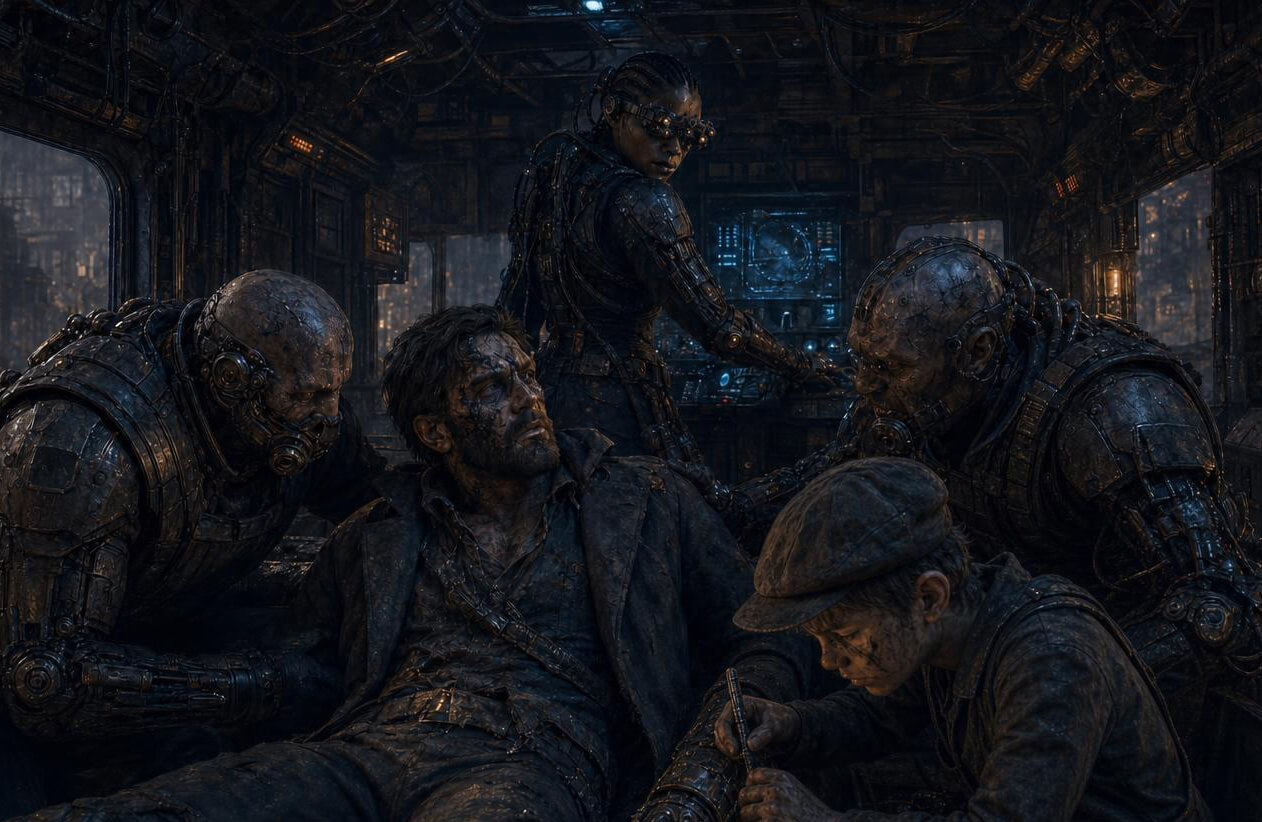
A Wire-Walker named Echo has just spent a month of her camp's medicine keeping a stranger's mind from burning out. Now the salvage sled is moving, and the stranger is waking up between two Juggers and a child who is already pricing his parts.
New here? Chapter 1, The Awakening, is where he opened his eyes.
AUDIOBOOK // COMPLETE CHAPTER
Chapter 2: The Rail-Sled. Full recording, 29 minutes
The complete chapter, narrated from the development audiobook. The text below is the same chapter in full. Audio loads only when you press play.
Consciousness returned in a slow sway. For the first time since the Boneyard, the electrical storm in his processor had subsided. The damage asserted itself immediately. Echo's premium chemical had bridged the gaps in his neural pathways, forcing a cold synthetic calm over his panicked systems. His visual sensors fluttered open and adjusted to the dim, toxic twilight without static flare.
He lay on a patchwork sled of corrugated steel and piping, powered by a stuttering engine. His attempt to turn triggered a wet grinding in his neck servos. The acute pain was gone, replaced by critical damage alerts.
Three others occupied the sled behind the engine block. Two were Juggers, broad-shouldered and soot-blackened, their prosthetics ticking in the cold. They sat on overturned fuel drums with the patience of workers used to waiting in bad weather. The third was smaller, organic, wrapped in a thick insulation blanket patched so many times it looked like a quilt of industrial offcuts. A child. Maybe eight. The child watched Pale-Iron with wide, unblinking eyes. Not fear. Assessment. The child had seen broken machines before and was already estimating salvage.
One of the Juggers noticed his movement. The man's face was a patchwork of burn scars and sub-dermal plating, one cheek reinforced with a brushed-copper panel riveted directly to the bone. He nudged his companion and pointed at Pale-Iron with a hydraulic finger that hissed faintly with each articulation.
"Wire-Walker got the ghost moving," the scarred man muttered. His accent was thick, the consonants worn down by decades of breathing chemical air, the rough rhythm of lower-tier Rust-Tongue. "Thought we'd be hauling scrap."
"He's not scrap," the second Jugger replied without looking up. She was repairing a length of braided copper cable, her mechanical fingers stripping insulation with practised, micro-precise movements. "Echo doesn't waste premium chemicals on scrap."
The scarred man grunted and returned his attention to the passing terrain, apparently satisfied.
Above him, the sky was a suffocating ceiling of industrial excretions and foul gas. Pillar-like structures pierced the smog and dropped into unseen depths. Toxic sediment drizzled down, coating the sled in a rusted gloss. Beyond the low railing, industrial devastation scrolled past: collapsed transit bridges over gulches of compressed waste; vast drainage channels, dry now, that had once carried coolant for dead systems. Their corroded walls glowed faint phosphorescent green, residue from an ancient process still leaching through the architecture.
The sled's runners screeched against the rail, throwing orange sparks into the twilight. The track was crude but clever: two salvaged rails bolted from mismatched sections, some polished smooth by traffic, others pitted and rust-eaten. At intervals, they crossed welded grating bridges suspended over gaps so deep no light reached the bottom. The sled lurched at each joint, and the child rode the motion without effort, one small hand gripping a rope loop bolted to the deck.
A low, resonant vibration passed through the rail beneath them. Not the sled's engine. Something deeper, transmitted through structural steel. Too low for human hearing, but Pale-Iron's acoustic sensors registered a steady pulse. Eleven point seven hertz. His core data flagged it and cross-referenced his fragmented technical library. Nothing. The vibration was everywhere and nowhere, a heartbeat in the machinery of the world.
The sled slowed. Ahead, the track curved around the base of a massive structural pillar, and the route narrowed between two cliffs of compressed refuse, decades of industrial waste compacted into walls twenty metres high, their surfaces glinting with embedded circuitry, crushed casing, and the occasional dull gleam of an intact fuel cell. Wire-scavengers had been here. Pale-Iron could see the excavation marks, narrow tunnels bored into the refuse walls, their openings marked with crude chalk symbols that his core data could not decode.
Echo brought the sled to a crawl. Her optical lenses were scanning the refuse walls, reading something in the chalk marks that the others on the sled did not seem to notice. She adjusted the tiller slightly, angling the sled toward the centre of the track.
"Toll zone," the scarred man muttered to his companion, reaching beneath his seat for something. His hand came back holding a small, sealed canister, aluminium, dented, with a hand-painted red stripe. He set it on the deck where it could be seen.
Pale-Iron's combat subroutines spun up automatically, overlaying his vision with green tactical reticles. Movement in the refuse wall. A figure emerged from one of the narrow tunnels, a wiry Jugger with a thermal visor pushed up onto her forehead and a bolt gun slung across her back. She stood on a ledge of compressed waste and looked down at the sled.
Echo raised one hand from the tiller. Two fingers extended, three folded. A gesture. The Jugger on the wall studied it, then repeated it back with a slight variation, two fingers, three folded, but the thumb rotated outward. Echo nodded. The Jugger disappeared back into the tunnel.
The sled accelerated again. The scarred man returned the canister to its hiding place beneath the seat.
Pale-Iron's vocaliser engaged for the first time since the crash. The sound was wrong: a flattened industrial rasp stripped of inflection, each syllable stamped out like sheet metal through a press. Not human. Not even a passable imitation. The modulator was damaged, cycling between diagnostic tone and seized-bearing grind. The words came slowly, selected through half-intact syntax libraries and pushed through failing throat hardware.
"What was that."
It was not inflected as a question. The rising tone that would have made it one was gone, burned out or buried somewhere in the wreckage of his voice. The words fell out flat and heavy, like bolts dropped on a steel deck.
Echo turned her head. Not fast, not startled, but with the careful slowness of someone who had learned that quick movements in the lower tiers got you shot. Her lenses clicked twice, refocusing, and she studied him. She had heard the grinding joints, the wet hiss of leaking fluid. She had not heard him speak. Until now he had been cargo. The voice changed that.
Her gaze held on him for three full seconds, reading something in the cracked faceplate, the shattered eye housing, the jaw that had barely managed to grind itself open. Then something shifted in her face, small and quick. She looked at him the way a scavenger looks at a component she had already stripped for dead and now finds humming under her fingers.
"What was that," he said again, because the response had not come and his conversation protocols could not parse silence as an answer.
"Sector recognition," Echo said without turning. "Different every, every cycle. Miss it and the scavengers cut the rail behind you. You're not going back. Only forward, and forward is priced."
The sophistication of it landed hard in his processor. These were not desperate survivors hiding in scrap piles. They were organized: signal codes, toll zones, rotating security. Whatever the lower tiers were, they were not chaos.
System stability: Critical. Motor functions: Compromised. Left hemisphere chassis breach detected. Thermal fluid leakage active. Structural integrity at thirty-two percent.
Something stirred in the deeper registers of his processing unit. Not Aera's clinical precision, but a heavier presence, a gravitational pull in the dark sectors of his architecture, ancient and vast. It did not speak words yet. It observed. It waited. And beneath the observation, like heat beneath stone, there was something that felt almost like interest.
He tried to access the presence directly, sending a diagnostic query into the dark sectors where it resided. The query returned nothing, not an error, not a refusal, but a deliberate silence. Whatever occupied those registers had the capacity to communicate and was choosing not to. Aera's analytical feed flagged the anomaly automatically.
Deep subsystem shows active processing, Aera noted, her tone carrying the faintest edge of what might have been caution. Communication status: passive. Classification: unknown. Recommend deferring investigation until primary systems are restored.
It was too structured, too purposeful to be an anomaly. He filed it away — another locked door in a house full of locked doors.
The rail-name Echo had hung on him before the standby still felt borrowed. Pale-Iron slowly pushed himself into a sitting position, and the illusion of his humanity immediately fell apart.
Beneath the grime and chemical burns, he could see the ghost of a master-crafted design, a machine meant to mimic the musculature of a twenty-three-year-old man. But half of that illusion had been violently torn away. The synthetic weave on his left side was sheared off entirely, laying bare the ribbed steel beneath. Frayed copper bundles and severed tendons hung from his shoulder, sparking faintly against the damp metal of the sled. Crimson warning diodes flickered erratically deep within his exposed chest cavity, illuminating a crushed power system that was barely maintaining his core temperature.
He raised his right hand, the intact one, and turned it slowly before his optical sensors. The synthetic skin was flawless. Under the grime, he could see individual pore textures, the shadow of tendons moving beneath the surface, the subtle gradient of colour at the knuckle joints. This hand had been built to pass for human at intimate range. The aesthetic precision was orders of magnitude beyond the prosthetics he'd seen on the Juggers around him. Whatever factory had manufactured this body had not been building workers or soldiers. It had been building a replica.
He flexed the fingers. The movement was fluid, silent, each joint articulating with a precision that made the sled's crude engine sound like a dying animal by comparison. His left hand, the damaged one, attempted the same motion and produced a grating, sparking horror of locked servos and exposed ligament cable. The contrast was physically painful to process. He was two halves of two different machines: one half art, one half ruin.
The scarred Jugger had been watching him test the hand. The man said nothing, but his expression shifted, the casual assessment of a veteran mechanic recognising a grade of manufacture he had no business encountering in the refuse tiers. He exchanged a glance with the cable-stripper, and something unspoken passed between them. Then both of them found other things to look at.
The word mirrored appeared in his diagnostic feed and evaporated before he could hold it. The classification meant nothing to him. The void in his memory swallowed it whole.
He was a ruined masterpiece, upper-tier manufacture dragged down to the same scrap he had been discarded among.
At the front of the sled, steering a braced mechanical tiller, stood Echo. She had removed her respirator mask, the harsh wind catching the metal rings woven into her short cornrows. Her dark skin was a map of survival, weathered, scarred, and embedded with sub-dermal wiring. The salvaged optical lenses replacing her eyes clicked as she scanned the dense fog ahead.
"Don't push the servos, metal-skin," she called back over the roar of the engine, her glowing gaze fixed on the rusted tracks. "Don't push —" The word looped, a stutter that wasn't mechanical but sounded like one, as if the sentence had been sent twice. "— your kinetic drive is warped. If you snap that primary piston in your shoulder, I don't have the premium parts to replace it."
Wire-Walker. She steered with the fluid economy of someone who had navigated this landscape for years, reading track the way a pilot reads currents, compensating for weight and chemical downdrafts.
"I am broken," Pale-Iron replied. His voice synthesizer startled him. It now was deep and resonant, but carried a jagged, mechanical stutter where his audio-processor had been crushed. "I am... incomplete."
"We are all incomplete down here," an older Jugger near the engine block muttered. He was missing his left arm, replaced by a hydraulic pincer hissing steam. His face carried deep creases around a single functioning eye; the other socket was covered by a riveted steel plate. His jaw held the permanent clench of someone who had stopped expecting comfort long ago. "You just wear your broken pieces on the outside."
"Leave him be, Corvus," Echo snapped, pulling back on the tiller as the sled took a screeching turn around a massive support pillar. "He needs the Weld. If we don't fuse those fuel lines, his neural unit is going to starve."
Corvus made a sound deep in his throat, not quite a grunt, not quite a laugh. He picked up a blunt iron wrench and resumed tightening bolts on the engine housing, his hydraulic pincer gripping the tool with surgeon-like delicacy. Three articulating digits, each a repurposed actuator joint, met at a point precise enough to hold a fuel cell without cracking the casing or crush a rivet flat. Corvus had used that arm long enough to fully integrate its geometry. He did not compensate for it. He thought through it.
The sled banked hard left. The track dove beneath an overpass of collapsed drainage infrastructure, pipe sections the width of a small building, fractured and draining a viscous amber fluid in slow, heavy curtains. The chemical smell thickened, sharp enough to sting Pale-Iron's intake sensors. The child on the deck pulled the insulation blanket over their head without being told. The scarred Jugger tugged a respirator mask from his belt and pressed it to his face. A practised gesture, performed without looking up.
Echo drove through the curtain of runoff without slowing. The amber liquid sheeted across the sled's deck, pooling in the seams of the corrugated steel. Her respirator hung at her belt, unused. Either she was immune to the chemicals, or she had decided the exposure was acceptable. Either way, she drove through the pollution the way a dockworker walked through rain.
Beneath the overpass, the light shifted. The perpetual orange twilight of Level Six gave way to a deeper, cooler tone, the bluish glow of chemical phosphorescence leaching from the infrastructure walls. The pipes above them groaned with internal pressure, their surfaces crusted with crystalline deposits that sparkled faintly in the sled's running lights. Water, or something that had once been water, dripped from the fractured joints, and where it fell, the rust had been washed clean, revealing the original surface beneath: brushed steel, still bright after millennia, stamped with corporate identification codes in a typeface that Pale-Iron's core data recognised but could not place.
The codes were behind the same firewall as everything else. He could feel the knowledge sitting in his architecture, sealed behind walls of encrypted silence. His processor knew what the stamps meant. It simply refused to tell him.
The child peeked out from beneath the blanket. Their eyes found the manufacturer stamps on the exposed pipe and lingered there for a moment. Then they looked at Pale-Iron, at the torn synthetic weave on his face, at the design precision of his intact right hand, at the corporate manufacture that no amount of grime could fully hide. The child said nothing. But the way they pulled the blanket back over their head was slightly different, tighter, as if they had seen something that made them want to disappear.
As the sled cleared the overhang and the chemical curtain fell behind them, the fog broke and revealed the Railmaker camp.
It was defiance made physical. The settlement hung between two colossal steel columns, a multi-tiered shantytown built from discarded corporate refuse. Walkways of welded grating zigzagged between habitats made from hollowed shipping containers and stripped transport husks. The whole structure was lit by scavenged neon and the roar of deep-smelting furnaces.
The sound hit him before the detail: layered percussion of hammers on metal, pneumatic hiss, the groan of stressed cable under load. Beneath it all throbbed the camp's primary generator, a massive diesel block bolted under the main platform, exhaust funnelled downward into the void to avoid thermal detection from above. It was not music, but it had cadence. Hammer strikes hit the beat. Cable winches released on the offbeat. Even sputtering neon seemed to flicker in time.
Towering above the main platform stood scrap effigies: abstract sculptures of twisted rebar, glowing circuit boards, and severed robot chassis. They looked like mechanical deities guarding the tribe, their surfaces vibrating with low-frequency signal jammers. The largest stood at the camp's northern point, a twelve-metre figure built from the fused remains of three gantry cranes, arms outstretched, head a cluster of dead sensor arrays aimed blindly at the smog. Someone had welded a chain of copper links around its neck; chemical exposure had turned it green. Offerings sat at its base: a coil of clean wire, a sealed canister of synthetic lubricant, a child's drawing scratched into scrap aluminum. Juggers who passed did not bow or pray, but many touched the base as they walked, hand to cold iron, like sailors touching a rail before shore.
The sled crept past a secondary platform connected to the main structure by a suspended bridge of braided steel cable and corrugated panels. On it, three Juggers were dismantling a piece of machinery that Pale-Iron's core data identified as an industrial compression unit. They worked methodically, stripping copper wiring, sorting fasteners by grade, stacking plates of usable steel in neat piles. Nothing was wasted. Every bolt, every wire, every scrap of insulation was evaluated, catalogued by some unspoken internal metric, and either stockpiled or fed to the furnace. The economy of the Weld was not currency. It was material. Weight. Load-bearing capacity.
A second team worked on a nearby platform, refitting anchor clamps with fresh bolts. Their movements were synchronized from repetition: one Jugger held the clamp steady while another torqued the bolt, a third pre-treated the next fastener with anti-corrosion paste. They did not speak. Rhythm was the language. Start, hold, torque, release. Start, hold, torque, release. The pattern repeated across the camp: small groups in silence, building, repairing, reinforcing. The Weld did not stop. It could not. The environment was always trying to dissolve it, and every neglected hour risked load-bearing failure.
The child on the sled stood up as they approached the dock, pulling the insulation blanket off and folding it with a practised, origami-like precision. The scarred Jugger and the cable-stripper were already on their feet, unhooking tie-down chains and preparing to disembark with the quiet efficiency of people who had done this hundreds of times. Nobody spoke. Nobody needed to.
"Welcome to the Weld," Echo said, cutting the primary engine. The sled groaned as it engaged the braking calipers, sliding to a grinding halt against a wooden docking platform.
The platform creaked under the sled's weight but held. The wood, real wood, dark and dense, salvaged from some structure that predated the metal tiers, had been reinforced with angle iron at every stress point. Pale-Iron's sensors registered the material's age. The grain was tight, the cellulose compressed by centuries of pressure. This was old growth from the lower carbon sinks, hauled up through the tiers over generations.
Pale-Iron tried to stand. His internal gyroscope spun wildly as he put weight on his left leg. The knee joint buckled with a horrific crunch of grinding metal, and he collapsed forward.
Echo was there instantly, her power suit whining under his immense density. Her insulated gloves gripped the exposed, cold steel of his back, holding him upright. Her fingers found the ridges of his spinal architecture without searching, the touch of someone who had already mapped him from the inside.
"Easy," she murmured, close to his auditory sensors. "All that upper-tier make won't help if your leg folds under you. Let the Weld hold you up."
Corvus dropped from the sled behind them, his hydraulic pincer clanging against the dock. He did not offer to help carry the weight. Instead, he walked ahead, clearing a path through the gathering crowd with brief, sharp gestures that the Railmakers obeyed without question. Whatever his role in this settlement, it carried authority, the blunt, practical authority of a man who had kept people alive long enough to earn their silence when he moved.
Dozens of Railmakers emerged from the shadows of their iron tents. Forged by the broken world around them, they were adorned with mechanical prosthetics and carried tools made from the bones of old machines. They did not look at him with fear or worship. As their eyes traced the sparking wires and the flawlessly rendered, yet torn skin of his face, they looked at him with the one thing he hadn't expected to find in the darkest reaches of the Upper Rust.
They looked at him the way workers looked at a machine dragged back from the edge: measuring the damage, already thinking about how to keep it running.
An older woman with a thermal apron and hands blackened to the wrist by carbon scoring stepped forward. She held a chemical lantern up to Pale-Iron's exposed chest cavity, squinting at the crushed fuel cells and the frayed copper wiring. She said nothing for several seconds. Then she turned to Echo.
"Seventh-generation fuel cells," the woman said. "Clean-room manufacture. I've only seen the casing in a salvage catalogue." She looked back at Pale-Iron. "Where did you get this one?"
"The Boneyard," Echo said. "He was in the refuse."
The woman's expression did not change. She handed the lantern to a nearby apprentice and pulled a pair of copper-tipped calipers from her apron. "I'll need twelve metres of braided eighteen-gauge. Clean copper. Not the recycled filament."
"We have eight," Echo replied.
"Then find four more before I start, or I'll be patching him with tin scrap and prayer."
She turned and walked toward the furnace without waiting for a response. The apprentice followed, already reaching for tool rolls.
Prepare yourself, little unit, the deep, echoing voice of Prometheus rumbled from the dark corners of his processing unit, vibrating through his ribs. They are going to bind you to this rust. Do not fight the fire.
Echo adjusted her grip on his back. She was looking at the furnace, where the old woman was already heating tools. Something moved behind Echo's amber lenses, a micro-expression that Pale-Iron's damaged optics barely caught. Not worry. Not calculation. Something older and quieter, carried in the tension of her jaw and the steady way she let the breath out through her teeth.
"Can you walk ten more metres?" she asked.
"Yes," he said. He wasn't certain it was true.
"Then walk," Echo said. "The Weld doesn't carry anyone the last ten metres. You arrive on your own feet, or you don't arrive."
She stepped back, releasing his weight gradually, watching his gyroscope fight for balance. His left knee locked, unlocked, locked again, the damaged joint grinding through its reduced range of motion with a sound like a file drawn across raw iron. His right leg compensated, shifting his centre of gravity, and for a moment he stood unsupported. Swaying. The crimson warning diodes in his chest cavity flickered in rapid sequence, painting the faces of the nearest Railmakers in pulsing red light.
He took the first step. The grating flexed under his weight; he was heavier than anything these walkways had been built to carry. The second step flexed harder, and a nearby Jugger glanced at the structural bolts with an evaluating expression. The third step was steadier. His internal gyroscope was learning the new parameters: the heavy lean of the iron strut, the reduced articulation in the knee, the way damaged cooling fans pulled his torso slightly left.
The Railmakers did not clear a path for him. They simply stood where they were and made room by turning sideways, the way people in a narrow corridor let a loaded cart pass. No deference. No performance. He was cargo in transit, and they were making space for the delivery.
At the seventh step, his left knee almost gave way again. The joint emitted a high-pitched squeal that drew every eye on the platform. Echo did not move to catch him. She stood exactly where she was, her amber lenses tracking his balance point, her hands loose at her sides. Ready, but not reaching. The distinction was deliberate.
He shifted his weight forward, letting his momentum carry him through the failure point. The knee held. Barely. But it held.
Ten metres to the anvil. Ten metres to whatever came next.
He arrived on his own feet.