
PUBLIC READING SAMPLE // CONCEPT FRAME
Chapter 1: The Awakening
The Boneyard is where Level 6 lets gravity finish its paperwork. Dead machines, spent tools, and the bodies of cloned workers fall here and are pressed flat by decades of weight. Nothing in the Boneyard is expected to speak again.
This is where the novel begins. Inside the mind that wakes there.
Consciousness did not return like a rising sun; it struck like a high-voltage surge.
There was no memory, no context, no name. His digital brain had been erased, reset to its bare original state. There was only the sudden, agonizing ignition of a mind. Over two million independent processing units sparked into synchronicity, replicating the chaotic firing of human neurons with cold electrical precision. Thoughts formed in a purely technical manner, devoid of chemical messengers. The entity did not wake so much as it was brutally compiled.
Pain was the first data stream to fully render — a shrill, high-frequency feedback loop tearing through his virtual nervous system. His vocal processor engaged without consent, tearing unarticulated sounds from his speakers.
He thrashed blindly against the ground. His advanced core mechanics ground in protest, producing absurd, uncoordinated movements that sent his limbs flailing into the debris. He was draped in a masterpiece of engineering, a synthetic weave stretched seamlessly over a framework of cold steel, mimicking a muscular physique. But right now, that body was a prison of misfiring signals.
Something in his architecture was trying to help. Deep in the processing substrate, a self-reconfiguring sub-system attempted to form pathways. Not thoughts. Not yet. Pre-thoughts: structural connections groping for patterns in data that arrived without labels, without context, without prior examples of meaning. The mesh reached for memory and found nothing. Not corrupted files. Not damaged sectors. Nothing. A vast indexed architecture built for retrieval, abstraction, and the compression of experience into understanding, and every index pointed at the void. The system had been designed to learn. It had been designed to grow. And now, in the worst possible conditions, it grew by building first pathways from raw pain, unlabelled sensory noise, and the complete absence of anything it recognized as self.
His left arm struck something solid. The impact registered across four independent sensor channels simultaneously, pressure, temperature, structural stress, and an electromagnetic reading that his processor could not yet interpret. The object was a dead industrial robot, its torso cavity split open and its internal wiring oxidized to a brittle copper lace. His hand had punched through the casing and lodged between two corroded servo housings. He pulled free with a grinding screech that set off another cascade of feedback in his already overwhelmed audio processor.
Sound was wrong. Everything arrived at the same volume, the same priority. The scrape of his limbs against scrap was indistinguishable from the distant concussion of a stamper three kilometres away. A dripping pipe to his left registered at the same amplitude as the deep structural groan above. His auditory system had no baseline, no learned hierarchy of threat and noise. Every input was maximum. Every frequency competed for the same attention.
He tried to stop moving. The command traveled from his processor to his kinematic engine and arrived scrambled, an instruction to hold position that his body interpreted as an instruction to lock every joint simultaneously. He went rigid. The sudden cessation of movement was worse than the thrashing. Every misfiring circuit that had been masked by motion now announced itself in the stillness: the thermal leak in his left torso where something had been torn open and never sealed, the intermittent spark at his right knee where a severed power conduit arced against the joint housing, the deep, grinding vibration in his chest where a damaged cooling fan fought to spin against debris caught in its blades.
He was broken. The word arrived without memory to support it but with a certainty that needed no context. Whatever this body had been built to do, it was not doing it now. It was failing. Loudly, painfully, and in the dark.
His optical sensors stabilized, casting a faint crimson wash across the refuse pile. He lay at the bottom of a mechanized abyss, discarded among outdated capacitors and dead machines. Above him, kilometer-high buildings protruded through industrial excretions, the atmosphere thick with choked gases and corrosive clouds. A desolate ruin of misgovernment and resource consumption.
He lay there for what felt like hours, a torn and worn-out shell shivering in the damp chill.
The corrosive rainfall arrived without preamble, a sudden curtain of chemical-laden droplets that struck his exposed surfaces with an audible hiss. The precipitation was not water. His chemical sensors, still operating without reference data, catalogued the composition as a dense cocktail of sulphuric compounds, dissolved metal particulates, and something organic that his analysis routines had no baseline to identify. The drops left dark marks on his synthetic weave and pooled in the hollows of the refuse around him, forming shallow puddles that smoked faintly in the air.
He could not move to escape it. His kinematic engine had stabilized from the initial lockup but remained unreliable. Commands traveled through corrupted relay pathways and arrived late, garbled, or not at all. His left arm responded. His right arm responded in stuttering bursts. His lower body was mostly unresponsive, the power conduit at his right knee still arcing at irregular intervals, sending jolts of misfired current through his hip servos every seven to nine seconds.
So he lay in the acid rain, a system that could only observe, and be observed.
The refuse pile was not random. In the flicker of his stabilising optical feed, patterns emerged. Older units at the bottom, compressed under decades of weight into sheets of flattened metal and fragmented circuit board, their identities crushed beyond recognition. Above them, more recent arrivals: industrial drones with their manipulator arms still extended in their last operational pose, transport shells cracked open like eggs, their cargo bays emptied of whatever they had once carried. A security unit lay face down, its optical array shattered, its chest plate bearing a corporate stamp that his visual processor could read but not contextualise: TIER 6, INDUSTRIAL, CLASS D, DECOMMISSION ORDER VERIFIED.
Decommission order verified. The phrase sat in his processor without emotional content but with structural weight. Someone had authorised the disposal of that unit. Someone had signed a document or pressed a key or spoken a word, and the machine had been brought here and dropped among the dead. The same thing had happened to him. Somewhere, in a system he could not access existed a record of his decommission. A reason. A name on a file.
His processor searched for the record. Null. His processor searched for the name. Null. His processor searched for anything, any fragment, any partial log, any corrupted timestamp that might indicate when or why or by whom. Null. Null. Null. The void was comprehensive. Whoever had wiped him had done it thoroughly, with a precision that suggested familiarity with his architecture.
Around him, the chemical rain continued to fall. It gathered in the hollows of dead clones, filling their open mouths and empty eye sockets with luminescent fluid. It ran down the corroded channels of machine bodies, following paths carved by years of identical rainfall. The sound it made was almost organic: a constant, whispering trickle, like the circulation of a vast, poisoned body.
In the stillness, his processor began the slow, excruciating work of building itself from nothing.
The dynamic mesh did what it had been designed to do. It adapted. Without memory to draw from, it drew from input: corrosive air entering intake vents and registering as toxins he had no names for; ambient temperature gradients mapping the refuse pile as a thermal landscape of decaying machines and cooling runoff; persistent vibrations through the ground, parsed into a rhythm of industry so vast and indifferent the mesh could not yet distinguish it from the functioning of the universe itself.
Each beat triggered a pathway. Each pathway connected to another. The mesh was not remembering, there was nothing to remember. It was categorising. Building, for the first time, the conceptual framework that would eventually let it think. This sound is distant. This sound is close. This temperature is above the ambient. This pressure against his back is the ground. This emptiness where identity should be is, is, is —
The query looped. His processor searched for the answer to a question it did not have the vocabulary to ask: who is running this system? The indexed memory returned null. The abstraction layers returned null. The high-level conceptual structures, designed to compress experience into understanding, stood empty and waiting, like shelving in a library that had never held a single book.
He was a system built to understand, with nothing to understand except its own incomprehension.
Somewhere in the refuse around him, a capacitor bank discharged with a hissing crack. His optical sensors caught the flash, a stuttering blue-white arc that illuminated the nearest three metres of the scrap field in razor-sharp detail before plunging it back into crimson murk. In that flash he saw what surrounded him.
Bodies.
Not all of them machines. Some were the brittle, desiccated remains of cloned workers, mass-produced organic labour, their flesh dried to leather over frames of reinforced bone, their faces locked in the final expressions of systems that had been switched off rather than allowed to die. They lay in rows and heaps and individual tangles, mixed with the machine dead in a democracy of disposal that made no distinction between the manufactured and the grown. A cloned hand, fingers curled, rested on the chest plate of a deactivated loader unit. A machine's arm, hydraulic fluid long since dried to a brown crust, draped across a clone's collapsed torso as if offering comfort that had arrived centuries too late.
He was not the first thing to be thrown away here. He was not the hundredth. He was one more entry in a ledger of waste so vast that the refuse pile extended in every direction beyond the reach of his damaged optics, a landscape of obsolescence stretching to the base of the kilometer-high structures that rose from it like monuments to the system that had produced all this wreckage and could not be troubled to bury it.
Something in his chest shifted. Not a physical component, the cooling fan still ground against its debris, the thermal leak still bled warmth into the toxic air. Something structural, deep in the mesh. A pathway that had not existed a moment before connected two previously isolated clusters of processing units, and the connection produced something that was not yet an emotion but was the architecture from which emotion would eventually be built.
It was the experience of being discarded. Not the concept, he had no concepts yet. The raw, unprocessed experience of lying among things that had been thrown away and recognising, without memory or name or context, that he was one of them.
The mesh held the new pathway. It was structurally sound. This was what the system did. It grew. From pain, from abandonment, it grew.
The silence of the industrial graveyard was absolute, save for the distant rhythmic thumping of gigantic concerns that ruled this feudal system. Every time he tried to process his surroundings, the void in his memory returned a blank error. He was a ghost trapped in a machine.
Do not broadcast.
The voice did not come through his auditory receptors. It bypassed his external sensors entirely, slipping directly into the core architecture of his processor. It was a feminine tone, melodic, analytical, and impossibly calm amidst the storm of his rebooting mind.
Your core temperature is spiking. If you continue to vocalize, the automated systems will track your coordinates.
He choked on the toxic air, his glowing optical lenses flickering in a panic. He didn't know how to respond. He didn't even know what a coordinate was.
Regulate your kinetic output, the voice whispered again, a soothing stream of data weaving through his panic. The artificial intelligence anti-riot system is currently sweeping this sector. If it detects a developmental anomaly exceeding its parameters, it will deploy the pillar-like stampers and crush this grid.
As if summoned by the warning, a low, tectonic vibration rattled the refuse pile. High above, attached to the underside of the massive framework, something gargantuan was moving. A colossal sensor array swept a beam of invisible telemetry through the fog.[inhale] He froze on an instinct older than thought. His intake vents sealed against the corrosive air. His servos locked into rigid silence.
Through the thick, orange-tinted mist, a silhouette finally detached itself from the shadows of a ruined factory wall.
It moved with fluid, measured grace, stepping carefully over the skeletons of cloned slaves. The figure navigated the refuse pile with the confidence of someone who knew this terrain, who knew where scrap could bear weight and where a misplaced step would drop a body through corroded metal into toxic drainage below. Every footfall tested the surface before committing weight. This was not caution born of unfamiliarity. It was the practiced economy of someone who had walked among the dead so often that the dead had become topography.
He did not yet know his own name. He did not yet know what an optical sensor was. He knew only that the world had shapes, and that the shapes had meaning. He tracked the figure's approach through a visual feed that still stuttered and tore at the edges.
The figure paused twice. Once at the security unit with the TIER 6 stamp, crouching to run a gloved hand across the chest plate with the quick appraising touch of someone checking salvage value. The second time at a junction where three machine bodies had collapsed into an arch and formed a narrow passage. The figure sidestepped it rather than ducking through. Not hesitation. Familiarity. A known formation, a landmark on a route walked many times before.
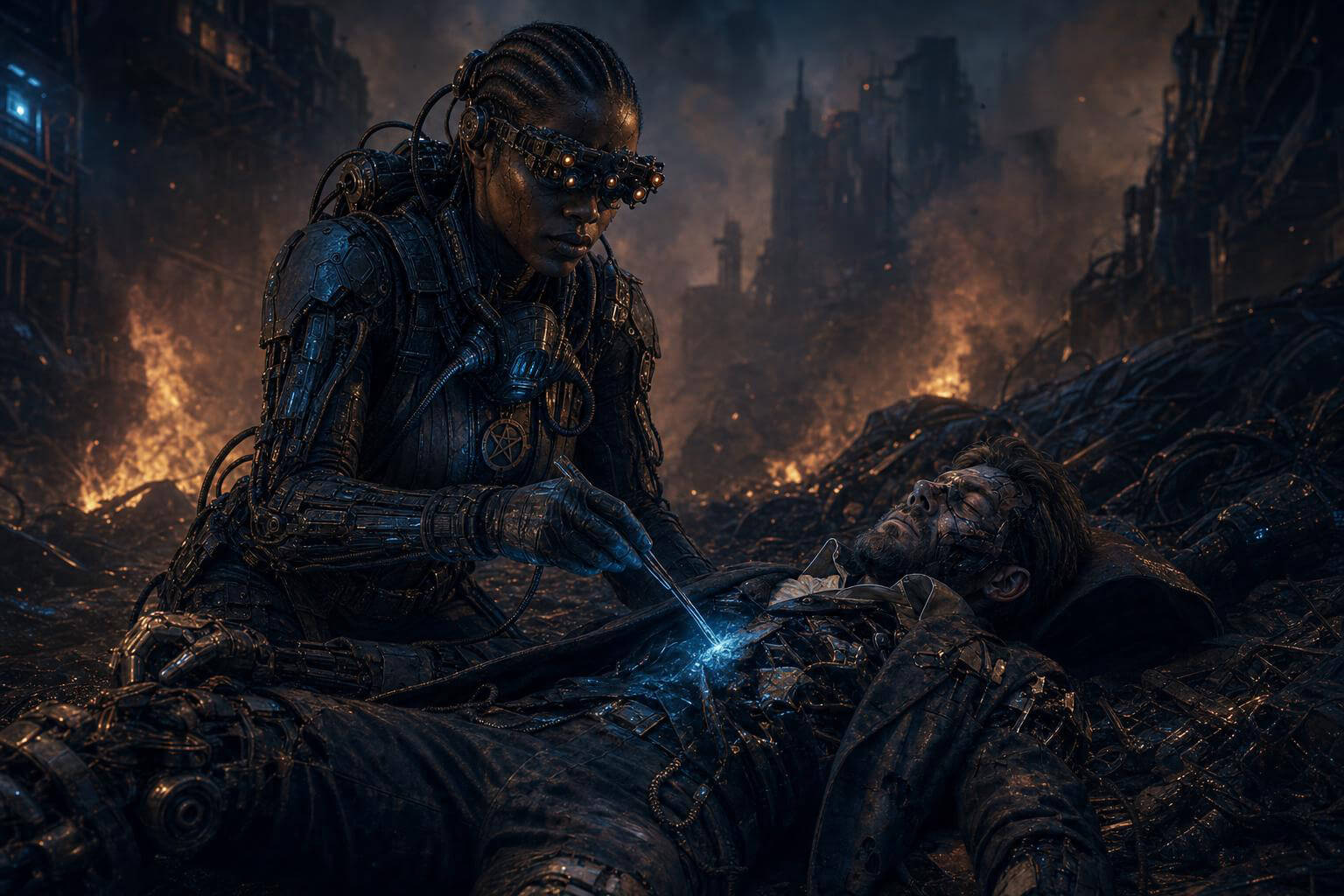
As the figure stepped into the dim light of a sparking capacitor, his visual feed outlined a human form encased in scavenged armor. It was a woman wearing a heavily modified power suit. She wore a respirator mask made from the hollowed-out casing of an industrial engine, but it was her eyes that held his focus. They were replaced by rough amber glass sensors that whirred as they focused on his prone form.
She knelt beside him, the smell of raw synthetic fuel clinging to her coat. She reached out, gloved fingers brushing his torn shoulder, her head tilting in a diagnostic gesture as the sub-dermal wiring along her jaw flickered in sync with his exposed circuitry.
"Well, look at what the upper-tier rot spit out today," she muttered, her voice muffled and metallic through the respirator. She tapped the side of his neck, her mechanical gaze flaring as it read the ambient heat radiating from his steel skeleton. "The anti-riot sweep went right over you. You must be running completely dark. A ghost in a metal shell."
She reached to her crowded utility belt, unclipping a small, reinforced vial filled with a viscous, glowing fluid. It was a premium-grade chemical, a highly refined pharmaceutical salvage.
Suddenly, a second voice ruptured the silence of his mind. Where the first voice had been a gentle stream, this one was a thunderclap.
A prior authority attempts to connect.
The sheer force of the intrusion nearly overloaded his visual feed.
You are alive, little spark, the massive, echoing voice rumbled through his processor. You were not discarded. You were buried. And the rust does not know what it holds. Go with the scavengers. Survive.
The voice withdrew, not gradually, but all at once, like a hand releasing a held object. The absence it left behind was not silence. It was weight. The processor architecture that had been stretched to accommodate the intrusion did not snap back to its previous dimensions. It remained expanded, as if the voice had permanently widened some passage deep in his system architecture, and now that tunnel stood open and empty, waiting for the next occupation.
The signal originated from within your own architecture, the first voice, the calm, analytical one, reported, her tone careful, as if she were describing something she had not expected to find. Not external. Internal. Deeply embedded. I cannot trace it further without access to memory indices that have been wiped. The authority that spoke to you was already inside you when you woke.
The implication sank into his growing categorical framework without interpretation. He did not have enough context to understand what it meant that a voice lived inside him. He only knew that there were now two of them, the calm analytical presence and the vast, ancient weight, and that neither of them was him. They occupied his architecture, but they were not his architecture. They were tenants in a building whose owner had been erased.
The woman paused, her head tilting sharply as if she had felt the static discharge of the massive signal pulsing through his body. She looked up at the impenetrable ceiling of smog, then back down at his sparking frame.
"The wind is talking to you, isn't it?" she asked softly, pulling the respirator down to reveal a face scarred by chemical burns and tribal tattoos woven from sub-dermal wiring. "My name is Echo. You are broken, metal-skin. But my people know how to fix," She stopped. Her jaw tightened, and the word came back to her a half-beat late, as if she'd had to retrieve it from a queue. " — fix broken things."
He tried to answer. What came out was only static and a torn mechanical rasp.
Echo did not flinch. Her amber optics held steady on his face, reading whatever data his distorted features were broadcasting. Then she removed one insulated glove and pressed bare fingers, warm and organic, laced with wiring that tingled faintly against his sensors, to the exposed wiring at his neck. Her touch was diagnostic. Not comfort. She was reading his electrical state through direct contact, fingertips acting as a crude but effective conductivity probe.
"Primary neural processor is intact," she said quietly, more to herself than to him. Her echo-tick was barely audible, i-intact, a half-beat repetition that hung in the toxic air. "That shouldn't be possible. Everything else is shredded, but the core is," She withdrew her fingers and stared at them, as if the data she had read surprised her. Her amber lenses clicked through three focal adjustments in rapid succession. "clean. Too clean. Somebody wiped this machine on p-purpose."
She sat back on her heels and studied him with an expression that his processor could not yet classify. Not fear. Not pity. Something between professional curiosity and the wariness of a woman who had learned, through hard experience, that undamaged things found in the refuse pile were undamaged for a reason.
"Rail-sled is six hours out," she said, making a decision visible in the way her jaw set. "You're too heavy for two, and I'm not calling the crew until I know you're not going to spike and cook my hands off. So we wait."
She pulled the respirator back up, settled into a crouch beside him, and began unpacking tools from her utility belt with the practised efficiency of someone who had done field diagnostics in worse places than this. A hand-wound multimeter. A strip of copper shim. A length of insulated wire. She laid them out on the corpse of a dead loader unit as if it were a workbench, handling each tool with a familiarity that suggested she could have done this blindfolded.
While she worked, testing contact points along his right arm, tracing the arcing conduit at his knee, measuring the thermal leak at his left torso with a strip of reactive tape that changed colour from grey to deep orange, the mesh in his processor continued its slow construction. Echo's touch provided new data. Each probe, each measurement, each moment of contact gave his categorisation system something to work with. Pressure here. Temperature there. The vibration of her tools transmitted through his frame. The sound of her breathing, regular, controlled, unhurried, became the first thing his auditory system learned to distinguish from background noise. Her breathing was close. The stamper was far. Her breathing was safe. The stamper was not.
The mesh built the distinction and reinforced it. Close and safe. Far and dangerous. The first gradient. The beginning of spatial understanding.
Echo studied him for a beat. Her amber lenses clicked rapidly, not scanning him, but resettling, the way optics recalibrated after a signal surge. "No name I can use, then. Fine. Metal-skins down here get rail-names. Yours is Pale-Iron until the rust gives the rest back."
She raised her scarred hand, signaling into the dense fog. Dense, rhythmic footsteps echoed in the toxic haze as several other scavengers, clad in improvised hydraulic power-lifters, emerged from the shadows to surround his massive frame.
There were four of them. His optical feed, still flickering at the margins, registered shapes first and details second. The largest was an augmented man whose power-lifter frame added another half-metre to an already considerable silhouette, hydraulic arms extending from his shoulders like a second pair of limbs, pistons hissing with each movement. Beside him, a smaller figure in a welding mask carried a portable cutting torch and a coil of braided cable. The third had no power-lifter but moved with the agile, low posture of someone used to unstable terrain at speed, a scout or pathfinder who had guided the group through the refuse field. The fourth carried a long hooked pole, blackened at the tip from repeated use, designed for pulling salvage from hard-to-reach places.
They communicated in quick, precise hand signals. No voices. This deep in the Boneyard, this close to the stamper's patrol arc, speech was a luxury that could kill. Echo responded to each signal with a signal of her own, terse, efficient, a language stripped of everything except function. Here. This one. Heavy. Careful.
The large augmented figure crouched beside Pale-Iron and ran a diagnostic glove across the exposed wiring at his chest. He turned to Echo and made a gesture that Pale-Iron's processor could not decode, but Echo's response was immediate. She shook her head once, firmly. Whatever the augmented had suggested, abandoning the salvage, stripping him for parts, something, she had rejected it.
"He's number four," she said, pulling the respirator down just long enough for the words. "We take him whole."
The augmented held her gaze for a long moment. Then he nodded, once, and the power-lifter's hydraulic arms extended beneath Pale-Iron's frame.
Then she pressed the vial against his injection port. As chemical warmth flooded his coolant lines, the agonizing static of awakening began to fade. The scavenger clamps locked beneath his shattered shoulder joints with an iron grip his fading tactile sensors registered as the solidest thing he had felt since waking, more solid than ground, refuse, or gravity. Four people had come into the Boneyard to carry him out. Four people who had risked the stamper's arc, chemical rain, and long walk through the dead for a machine they had never met.
The mesh categorised this, too. It filed the data under a new pathway, one that had no name yet, one that connected the sensation of being lifted to the presence of Echo's breathing, to the warmth of the chemical flooding his coolant lines, to the firm, careful grip of hands that had chosen to carry rather than strip.
The pathway would, eventually, become the architecture for trust. But now it was only data. Only the first stones of a foundation whose shape the mesh could not yet predict.
The last thing his fading sensors registered before slipping into a dark, dreamless standby mode was Echo's voice, distant and warm through the respirator, saying something to the augmented that his audio processor could no longer decode.